Guilin & Yangshuo 2026: Karst Landscapes, Cycling Routes & Where to Base Yourself
Guilin & Yangshuo 2026: Karst Landscapes, Cycling Routes & Where to Base Yourself Go beyond the basic comparison: understand the karst geology, master the cycling routes, navigate water levels for rafting, discover cormorant fishing culture, and decide between Guilin, Yangshuo, or Xingping as your base. Topics: Places, Nature, Where to Stay, First Trip.
Guilin and Yangshuo are often sold as one destination, but they solve different travel problems. Guilin is the transport hub; Yangshuo puts you closer to the countryside most people imagine when they picture the region. But there’s a third option that many travelers miss: Xingping, a small town 30 minutes north of Yangshuo that offers the most authentic karst experience without the tourist crowds.
Understanding the landscape: why the karst looks like this
The dramatic limestone peaks around Guilin and Yangshuo are not random — they are the result of 300 million years of geological processes. Understanding the geology transforms what looks like “pretty mountains” into a landscape with history.
How karst forms: During the Carboniferous period (about 300 million years ago), this region was under a shallow sea. Marine sediments — shells, coral, and chemical deposits — accumulated in thick layers of limestone. Tectonic forces later lifted the seabed above water, and rainwater (slightly acidic from dissolved CO₂) began dissolving the limestone along cracks and joints. Over millions of years, this created the characteristic tower karst landscape: isolated peaks rising 100-300 meters from the flat valley floor, with caves, underground rivers, and sinkholes hidden beneath.
What you’re seeing:
- Tower karst: The isolated peaks around Yangshuo are the classic “Chinese landscape painting” form. They form where dissolution is most intense, leaving behind resistant towers.
- Fenglin (peak forest): The clustered peaks you see from cycling routes. These are in the early stage of karst evolution.
- Fengcong (peak cluster): Peaks connected at their bases, seen around Xingping. More mature karst.
- Underground rivers: The Li River and Yulong River follow paths carved by ancient underground drainage systems.
- Caves: Reed Flute Cave (Guilin) and Silver Cave (between Guilin and Yangshuo) are solution caves formed by water dissolving limestone from inside.
Why it matters for your trip: The geology explains why the landscape looks different at different times of day. Morning mist fills the valleys between peaks because cold air drains downhill and pools. Afternoon sun creates dramatic shadows on the peak faces. Rain makes the limestone darker and more contrasty. Understanding this helps you plan photography timing.
UNESCO recognition: The South China Karst (which includes Guilin) is a UNESCO World Heritage Site, recognized for “the most complete and representative carbonate karst features in the world.” This is not just pretty scenery — it is scientifically significant.
The three bases: Guilin, Yangshuo, or Xingping?
Most guides frame this as “Guilin or Yangshuo,” but Xingping is a legitimate third option that many travelers overlook.
| Factor | Guilin | Yangshuo | Xingping |
|---|---|---|---|
| Atmosphere | Mid-size Chinese city | Tourist town, lively but commercial | Small riverside town, authentic |
| Best for | Transport convenience, city sights, one-night stop | Cycling, nightlife, range of activities | Photography, quiet, authentic karst life |
| Crowds | Moderate (city crowds) | High in West Street area, moderate in countryside | Low except at ¥20 viewpoint |
| Accommodation | Business hotels, 4-5 star chains | Boutique hotels, countryside resorts, hostels | Family guesthouses, small inns |
| Dining | Authentic local food, rice noodles | Tourist-oriented, some good local spots | Basic but authentic, beer fish specialty |
| Nightlife | Lakeside bars, quiet | West Street bars, lively | Almost none, quiet evenings |
| Transport | Airport, train, bus hub | Bus from Guilin only | Bus from Yangshuo (30 min) |
| Time needed | Half day to 1 night | 2-3 nights minimum | Half day to 1 night |
| Budget (mid-range) | ¥300-600/night | ¥300-800/night | ¥150-400/night |
When to choose each:
- Guilin: Late arrival or early departure, want city comforts, interested in caves and city parks, using as transport hub only.
- Yangshuo: Want cycling, range of activities, nightlife, boutique accommodation, easy access to countryside.
- Xingping: Want quiet authenticity, photography focus, willing to sacrifice convenience and nightlife, budget-conscious.
The practical recommendation: For a 3-night trip, arrive in Guilin (1 night if needed for transport), then base yourself in Yangshuo (2 nights) with a half-day trip to Xingping. For 4-5 nights, consider splitting between Yangshuo (2-3 nights) and Xingping (1-2 nights) to experience both the lively and quiet sides of the karst landscape.
Water levels: how they affect your activities
The Li River and Yulong River are not static — water levels change dramatically by season, and this directly affects what activities are possible and how good they are.
| Month | Water level | Impact on activities |
|---|---|---|
| Jan-Feb | Low | Bamboo rafting may be limited or unavailable. Li River cruise always runs. |
| Mar-Apr | Rising | Good for rafting, rivers fuller. Some low banks may be inaccessible. |
| May-Jun | High (rainy season) | Rafting at its best, rivers dramatic. Heavy rain may cause temporary suspensions. |
| Jul-Aug | High | Peak rafting season. Afternoon thunderstorms may disrupt afternoon activities. |
| Sep-Oct | Moderate-high | Ideal conditions. Rivers full but stable, good visibility, comfortable temps. |
| Nov-Dec | Falling | Rafting still available but rivers lower. Some shallow sections may require walking. |
What this means for planning:
- Bamboo rafting: Best May-October when water is high enough. In low water (Jan-Feb, sometimes Nov-Dec), some sections are suspended or replaced with motorized rafts.
- Li River cruise: Runs year-round regardless of water level. The large boats have sufficient draft.
- Cycling: Unaffected by water levels, but riverside paths may be muddy after heavy rain.
- Photography: High water creates more dramatic reflections. Low water exposes sandbars and creates a different aesthetic. Mist is most common in spring and early morning.
How to check current conditions: Ask your hotel — they know the current water situation and whether rafting is running. You can also check with the Yangshuo Tourism Bureau or ask on TripAdvisor forums for real-time updates.
Cormorant fishing: the living tradition
One of the most photographed scenes in Guilin is a fisherman standing on a bamboo raft with cormorant birds perched on poles. This is not a staged performance (though it has become partly commercialized) — it is a 1,000-year-old fishing technique that is now more valuable as a photo subject than as actual fishing.
The history: Cormorant fishing (鸬鹚捕鱼, lúcíbǔyú) was practiced along the Li River for centuries. Fishermen would train cormorants to catch fish, then retrieve the fish from the birds’ throats. A ring was placed around the cormorant’s neck to prevent it from swallowing larger fish. This was a sustainable fishing method that worked in harmony with the river ecosystem.
Where to see it today: The tradition survives primarily as a photography subject. You can find cormorant fishermen at:
- Xingping: Along the Li River at dawn (6-7am). These are real fishermen (or their descendants) who now earn more from photography tips than from fishing.
- Yulong River: Less common, but occasionally spotted in early morning.
- Tourist performances: Some hotels and tour operators arrange cormorant fishing demonstrations. These are staged but allow closer photography.
The “photo tip” system: When you see a cormorant fisherman, he will likely ask for ¥10-20 for a photo. This is not a fee — it is a tip for his time. He will position the raft, light a lantern, and sometimes release the cormorants into the water for action shots. In low light (dawn), he may use a lantern to create atmosphere. This is a legitimate cultural exchange — the fishermen earn income, and you get authentic photos.
Photography tips:
- Best time: Dawn (6-7am) when light is soft and mist is likely.
- Lens: 70-200mm is ideal. You want to capture the scene from a distance without disturbing it.
- Composition: Include the karst peaks in the background, the mist on the water, and the fisherman with his birds.
- Etiquette: Ask before shooting, pay the tip, and do not demand multiple takes. These are real people, not performers.
Cycling safety and road conditions
Cycling is the best way to experience the karst landscape, but it comes with specific risks and considerations that most guides do not mention.
Road conditions by route:
- Yulong River Valley: Paved, flat, mostly car-free after Gongnong Bridge. Some sections have gravel after rain. Safe for all fitness levels.
- Ten Mile Gallery: Paved but busy with tourist buses on weekends. Ride early morning or weekdays. Shoulders are narrow in places.
- Xingping countryside loop: Mixed surface — paved main roads, unpaved farm tracks. Some sections become muddy and slippery after rain. Suitable for experienced cyclists only.
Safety considerations:
- Traffic: Cars and e-bikes share the roads. E-bikes are silent and may pass without warning. Ride single file, stay right, and use a bell.
- Weather: Afternoon thunderstorms are common May-September. Carry a rain jacket and know where to take shelter. Lightning on exposed valley roads is a real risk.
- Hydration: Carry at least 1.5L of water. There are few shops on countryside routes.
- Navigation: Download offline maps before you go. Cell service is generally good, but some valleys have weak signal.
- Bike condition: Check brakes and tires before setting out. Rental bikes vary in quality. If something feels unsafe, return it and try another shop.
- Insurance: Travel insurance typically covers cycling accidents, but check your policy. Some exclude “extreme sports” — cycling usually does not count, but confirm.
What to do if something goes wrong:
- Flat tire: Most rental shops will come to pick you up if you call. Keep the shop’s phone number. Alternatively, push the bike to the nearest village — there are usually small repair shops.
- Breakdown far from town: Flag down a passing vehicle. Chinese drivers are generally helpful. The driver may take you and the bike back to Yangshuo.
- Injury: Minor injuries can be treated at Yangshuo People’s Hospital (阳朔县人民医院). For serious injuries, call 120 (ambulance). The hospital in Guilin is better equipped.
Local specialties beyond rice noodles
Guilin rice noodles (桂林米粉) get all the attention, but the region has distinctive dishes you won’t find elsewhere in China.
Must-try local dishes:
| Dish | Chinese | What it is | Where to find it | Price |
|---|---|---|---|---|
| Beer fish | 啤酒鱼 | Fish braised in beer with tomatoes and peppers | Yangshuo restaurants, especially on West Street | ¥60-120 |
| Blood duck | 血鸭 | Duck stir-fried with duck blood and spices | Guilin local restaurants | ¥50-80 |
| Oil tea | 油茶 | Bitter tea made from roasted tea leaves and nuts | Guilin, ethnic minority restaurants | ¥10-20 |
| Li River fish | 漓江鱼 | Fresh fish from the Li River, steamed or braised | Yangshuo and Xingping restaurants | ¥50-100 |
| Bamboo tube rice | 竹筒饭 | Sticky rice cooked in bamboo tubes | Street vendors, ethnic minority areas | ¥10-15 |
| Water chestnut cake | 马蹄糕 | Sweet steamed cake made from water chestnuts | Guilin snack shops | ¥5-10 |
Beer fish deep dive: This is Yangshuo’s signature dish. The traditional version uses carp from the Li River, braised in local beer (usually Guilin Beer or Tsingtao) with tomatoes, green peppers, ginger, and garlic. The result is tender fish in a rich, slightly sweet sauce. It is best at small local restaurants, not the tourist traps on West Street. Look for places where locals are eating. The dish is not spicy by default — ask for 加辣 (jiā là, “add spice”) if you want it hotter.
Oil tea deep dive: This is a Guilin specialty with ancient origins, particularly among the Yao and Dong ethnic minorities. The tea is made by roasting tea leaves with ginger, then pounding them in a mortar and boiling with water. The result is a bitter, energizing drink served with various accompaniments: fried dough, peanuts, puffed rice, and pickled vegetables. It is an acquired taste — the bitterness is strong, but the accompaniments balance it. Oil tea is traditionally a morning drink and is believed to aid digestion and warm the body.
The Impression Sanjie Liu show: is it worth it?
Directed by Zhang Yimou (who directed the 2008 Beijing Olympics opening ceremony), Impression Sanjie Liu (印象·刘三姐) is an outdoor night show set on the Li River with karst mountains as the backdrop. It is one of China’s most famous tourist performances — but is it worth ¥198-680?
What you get:
- 70-minute performance with over 600 performers
- Set on a purpose-built stage in the Li River, with the natural karst landscape as scenery
- Lighting effects, music, and choreography based on Zhuang minority folk songs
- Seats range from standard (¥198-280) to VIP (¥380-680)
The pros:
- Visually spectacular, especially the scale and use of the natural landscape
- Unique experience — nowhere else in China offers a show on this scale in a natural setting
- Good introduction to Zhuang minority culture and folk songs
- Professional production values
The cons:
- Expensive, especially VIP seats
- Can feel touristy and commercialized
- Weather-dependent — shows are canceled in heavy rain
- The story (based on a folk legend) is thin — it is mostly visual spectacle
- Large crowds — arrive early to get to your seat
Which seats to choose:
- Standard seats (B or C area): Good enough for most people. You can see the full stage and the mountain backdrop. ¥198-280.
- VIP seats (A area): Closer to the stage, better sightlines, but you lose some of the panoramic effect. ¥380-480.
- Premium VIP (center rows): Most expensive, but the view is not dramatically better than A area. Skip unless you want the best photo angles. ¥580-680.
My recommendation: If you enjoy large-scale performances and have the budget, it is a memorable experience — but not essential. The show is at its best on a clear night with a full moon (check the lunar calendar). If you are budget-conscious or prefer authentic cultural experiences over commercial shows, skip it and spend the evening cycling by moonlight or drinking beer at a riverside bar.
Hiking Xianggong Mountain: the best viewpoint
Xianggong Mountain (相公山) offers the most iconic view of the Li River bend with karst peaks — the view that appears in countless Chinese landscape paintings and photographs. The hike is short but steep, and the timing matters for the best experience.
The hike:
- Starting point: Parking area at the base of the mountain (accessible by car or taxi from Xingping, about 20 minutes)
- Duration: 20-30 minutes up, 15-20 minutes down
- Difficulty: Moderate. Steep stairs with some handrails. Not suitable for people with knee problems or poor fitness.
- Cost: ¥60 entry fee
- Best time: Sunrise (5:30-6:30am) for mist and golden light. Sunset is also beautiful but less dramatic.
What to expect: You climb through bamboo forest and emerge at a viewing platform overlooking the Li River. The view is stunning — the river bends in an S-curve, flanked by karst peaks on both sides. In the morning, mist fills the valleys, creating layers of peaks fading into the distance. This is the view that defines Guilin in the popular imagination.
Photography tips:
- Lens: Wide-angle (16-35mm) for the panoramic view, telephoto (70-200mm) to compress the peaks.
- Composition: Include the river bend in the foreground, the peaks in the middle ground, and mist or clouds in the background.
- Timing: Arrive before sunrise to set up. The best light lasts about 30 minutes after sunrise.
- Crowds: Xianggong is popular with photography groups. On weekends, the viewing platform can be crowded. Go on weekdays if possible.
Getting there: From Xingping, hire a taxi or driver to take you to Xianggong Mountain and wait while you hike. The round trip (including waiting time) costs about ¥100-150. Alternatively, some hotels in Yangshuo organize sunrise photography tours that include transport.
Longsheng Rice Terraces: the day trip worth considering
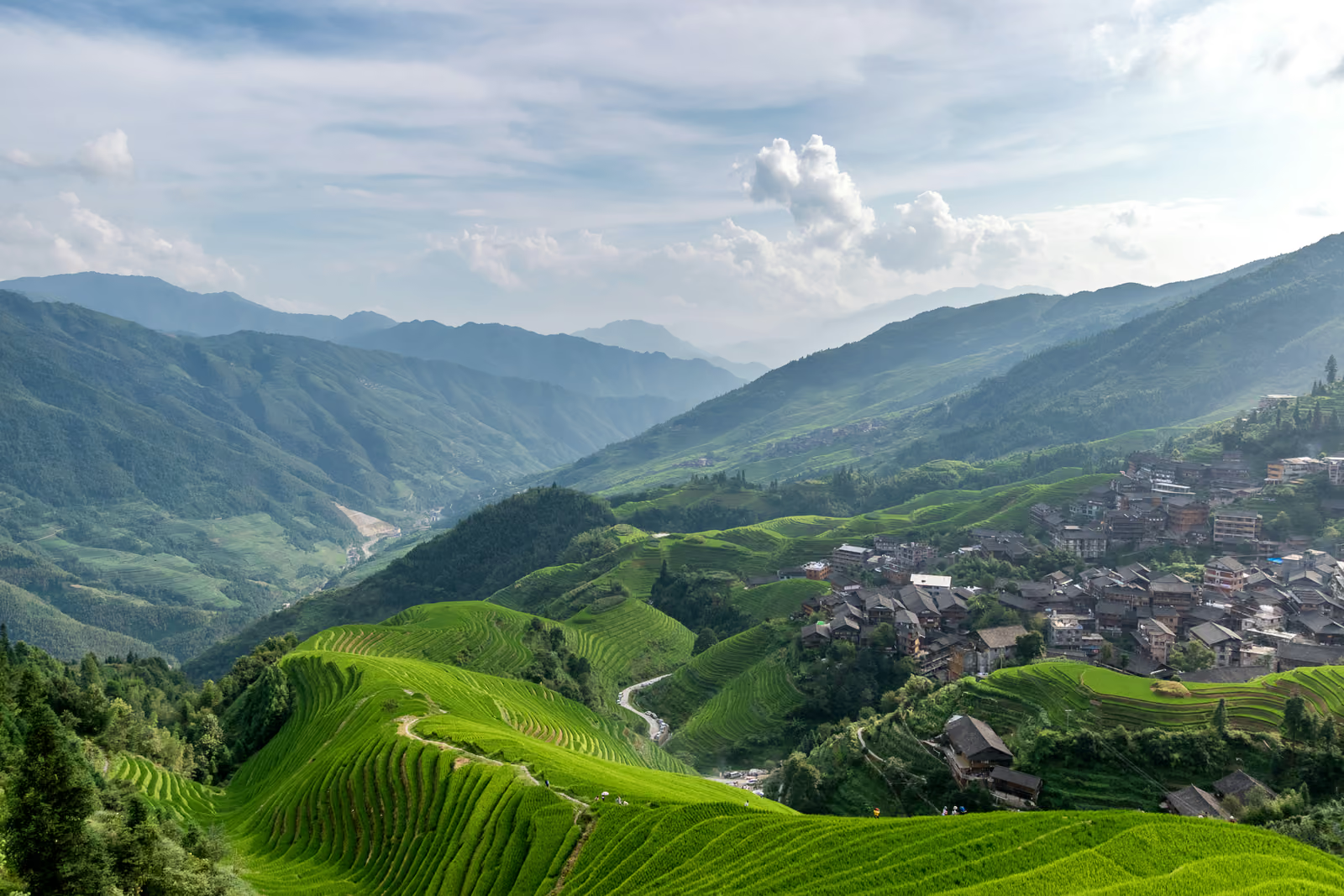
If you have an extra day, the Longsheng Rice Terraces (龙脊梯田, Lóngjǐ tītián) offer a completely different landscape experience — terraced rice paddies carved into steep mountainsides, created by the Zhuang and Yao ethnic minorities over 700 years ago.
Getting there:
- From Guilin: 2-3 hours by bus or private transfer
- Best as an overnight trip (1 night in the terraces) or a very long day trip
- Bus departs from Guilin Qinshan Bus Station (桂林琴潭汽车站), about ¥50
What to expect:
- Two main terrace areas: Ping’an (平安, more developed, easier access) and Jinkeng (金坑, more spectacular, more remote)
- Terraces rise from 300m to 1100m elevation
- Best time: May-June (water-filled terraces, rice planting) and September-October (golden rice, harvest)
- Ethnic minority villages with distinctive architecture and culture
- Moderate hiking between villages (2-4 hours)
Is it worth the detour? If you have 4+ days in the Guilin region and enjoy hiking and ethnic minority culture, yes. The terraces are a UNESCO Globally Important Agricultural Heritage System and offer a completely different experience from the karst landscape of Yangshuo. If you are short on time or primarily interested in karst scenery, skip it and focus on Yangshuo and Xingping.
Activity comparison: Guilin vs Yangshuo
| Activity | Guilin | Yangshuo | Verdict |
|---|---|---|---|
| Cycling | Park paths only | World-class countryside routes | Yangshuo |
| Bamboo rafting | Not available | Yulong River (quiet, scenic) | Yangshuo |
| Li River cruise | Departs from Guilin pier | Arrives at Yangshuo pier | Guilin (departure point) |
| Hiking | Seven Star Park hills | Xianggong Mountain, old town trails | Yangshuo |
| Nightlife | Two Rivers lakeside bars | West Street, riverside bars | Tie — different vibes |
| Photography | City landmarks, pagodas | Karst peaks, rivers, rice paddies | Yangshuo |
| Food scene | Authentic local rice noodles | Tourist-oriented, some good local spots | Guilin (authenticity) |
| Budget dining | ¥15-30 per meal | ¥25-60 per meal in town | Guilin |
| Luxury stays | 4-5 star hotels ¥500-1200 | Boutique countryside hotels ¥600-2000+ | Yangshuo (character) |
| Transport links | Airport, train station, bus hub | Bus from Guilin only | Guilin |
Li River cruise: booking tips and what to expect
The Li River cruise from Guilin to Yangshuo is the classic way to see the karst landscape that appears on the ¥20 banknote.
Boat types and prices (2026):
| Class | Price | Seats | Includes | Worth it? |
|---|---|---|---|---|
| 3-star boat | ¥210-250 | 4-seater tables | Basic lunch or snack | Budget option, crowded |
| 4-star boat | ¥320-360 | 6-8 person tables | Buffet lunch, upper deck access | Best value for most travelers |
| VIP deck upgrade | +¥50-80 | Open-air upper deck | Better photos, fresh air | Worth it on clear days |
Booking tips:
- Book 2-3 days ahead in peak season (April-October). Your hotel can arrange this.
- Boats depart at 9:30am from Guilin’s Zhujiang Pier (珠江码头). Arrive 30 minutes early.
- The cruise takes about 4 hours downstream.
- Bring sunscreen and a hat — the upper deck has no shade.
- The best scenery section is between Xingping and Yangshuo (last 1.5 hours). Sit on the right side going downstream.
- The 3-star boats can feel like a floating banquet hall — loud, crowded, with karaoke on the PA system. The 4-star boat is noticeably quieter.
Cycling routes around Yangshuo
Route 1: Yulong River Valley (easiest, most popular)
- Distance: 15 km one way
- Time: 2-3 hours with stops
- Highlights: River views, water buffaloes, rice paddies, moon-shaped hill viewpoint
- Road surface: Paved, flat, mostly car-free after Gongnong Bridge
Route 2: Ten Mile Gallery (十里画廊)
- Distance: 10 km one way
- Time: 1.5-2 hours with stops
- Highlights: Dramatic karst formations, small villages, roadside cafés
- Note: Can be busy with tourist buses on weekends
Route 3: Xingping countryside loop (for experienced cyclists)
- Distance: 25 km loop
- Time: 3-4 hours
- Highlights: The ¥20 banknote viewpoint, fishing cormorant boats (early morning)
- Note: Some unpaved sections — avoid in wet weather
Rental tips:
- Basic bikes: ¥20-30/day. E-bikes: ¥50-80/day.
- E-bikes are worth it for Route 3 or if you want to cover more ground.
- Start early (before 9am) to avoid midday heat and crowds.
3-night itinerary suggestion
| Day | Morning | Afternoon | Evening |
|---|---|---|---|
| 1 | Arrive Guilin airport/train | Elephant Trunk Hill, Reed Flute Cave | Two Rivers and Four Lakes night walk |
| 2 | Bus to Yangshuo (1.5 hrs) | Check in, cycle Yulong River route | West Street dinner, optional Impression show |
| 3 | Bamboo raft on Yulong River | Xingping half-day (¥20 viewpoint, Li River walk) | Return to Guilin or stay another night |
The useful split
For three nights, arrive through Guilin and spend most or all of the stay near Yangshuo. Add a Guilin night if it protects an early connection. The best base is the one that matches the daily experience you want — countryside cycling and riverside calm in Yangshuo, or transport convenience and city energy in Guilin.
The karst landscape that defines this region is unique to southern China and a few other places in the world. Understanding the geology, respecting the water levels, and taking time for the cultural details — cormorant fishing, oil tea, ethnic minority villages — transforms a scenic visit into a meaningful one. This is not just a photo destination; it is a living landscape with 1,000 years of human adaptation to a challenging environment.
If you are planning a longer nature-focused trip, the Yunnan two-week route offers highland landscapes and ethnic minority culture that complement the karst experience. For a completely different geological formation, Zhangjiajie’s sandstone pillars are worth considering. When you are ready to plan your overall budget or figure out how to get between cities, those guides cover the logistics.
Guilin city itself: what to do when you are not heading straight to Yangshuo
Most guides rush through Guilin on the way to Yangshuo. But Guilin has its own attractions — especially useful if you arrive late, have an early departure, or want an extra day.
What to do in Guilin city (1–2 days):
| Attraction | Cost | Time needed | Why go |
|---|---|---|---|
| Reed Flute Cave (芦笛岩) | ¥90 | 1.5 hours | The most spectacular karst cave near Guilin. Stalactites and stalagmites illuminated in colorful lights. Cool inside even on hot days. |
| Seven Star Park (七星公园) | ¥55 | 2 hours | Guilin’s largest park. Includes Seven Star Cave, a camel-shaped hill with views, and a small zoo with giant pandas. |
| Elephant Trunk Hill (象鼻山) | ¥55 (or free from the south side) | 30–60 min | Guilin’s iconic landmark — a hill that looks like an elephant drinking from the river. Best viewed from the south bank (free) at sunset. |
| Two Rivers and Four Lakes night cruise (两江四湖) | ¥180–220 | 90 min | Evening boat ride through the city’s waterways with illuminated bridges and pagodas. Touristy but atmospheric. |
| Guilin rice noodles breakfast | ¥8–15 | 30 min | The city’s signature breakfast. See the food guide below for where to go. |
| Zhengyang Road pedestrian street (正阳路步行街) | Free | 1–2 hours | Shopping, street food, and people-watching in the city center. |
| Fubo Hill (伏波山) | ¥55 | 1 hour | Riverside hill with a cave that frames a view of the Li River. Less crowded than Elephant Trunk Hill. |
When to spend a day in Guilin:
- You arrive at Guilin airport or train station after 3pm — it is not worth driving to Yangshuo in the dark. Stay one night in Guilin.
- You have an early flight out of Guilin — spend the morning seeing one or two city attractions before heading to the airport.
- You want a rest day between more intensive activities — Guilin’s parks and caves are gentler than Yangshuo’s cycling and hiking.
Guilin city food — the rice noodle capital:
Guilin is the birthplace of 桂林米粉 (Guìlín mǐfěn, Guilin rice noodles) — thin, round rice noodles served in a light broth or dry with toppings. This is different from the thicker rice noodles (米线, mǐxiàn) found in Yunnan.
| Style | Chinese | What it is | Price |
|---|---|---|---|
| Dry noodles with gravy | 卤菜粉 (lǔcài fěn) | Noodles with a thick savory gravy, topped with crispy pork, peanuts, pickled vegetables, and chili | ¥6–10 |
| Soup noodles | 汤粉 (tāng fěn) | Noodles in a light pork bone broth with toppings | ¥8–12 |
| Horse meat noodles | 马肉米粉 (mǎròu mǐfěn) | A Guilin specialty — noodles with sliced horse meat. Controversial for some visitors, but considered a local delicacy. | ¥10–15 |
| Sour noodles | 酸辣粉 (suānlà fěn) | Hot and sour rice noodles with peanuts and pickled bamboo shoots | ¥8–12 |
Where to eat rice noodles in Guilin:
- Chongshan Rice Noodles (崇善米粉) — A local chain with multiple locations. Clean, fast, and popular with locals. ¥8–12.
- Minglang Rice Noodles (明浪米粉) — Near the center, known for the best dry noodles with gravy. ¥6–10.
- Morning markets — The best rice noodles are at small stalls near morning markets. Look for queues of locals — this is always a good sign. ¥5–8.
Pro tip: In Guilin, rice noodles are a breakfast food. The best shops sell out by 10am. Go early.
Bamboo rafting: the complete guide
Bamboo rafting is one of the most iconic experiences in the Guilin/Yangshuo area — floating down a river surrounded by karst peaks. But there are multiple options with very different experiences.
The three rafting routes compared:
| Route | Duration | Price | Karst views | Crowds | Best for |
|---|---|---|---|---|---|
| Yulong River (遇龙河) manual raft | 1.5–2 hours | ¥200–320 per raft (2 people) | Excellent — intimate, quiet stretches | Moderate | The classic experience. Manual bamboo raft — poles only, no motor. |
| Li River (漓江) motorized raft | 4 hours | ¥210–360 | Good — wider river, more dramatic peaks | Heavy | Longer trip, covers more distance. Motorized raft — louder but covers the famous stretch. |
| Yulong River short route | 40–60 min | ¥100–150 per raft | Good — same river, shorter section | Light | Budget option or if you are short on time. |
Yulong River rafting — detailed guide:
The Yulong River is a tributary of the Li River, much narrower and quieter. The rafts are traditional bamboo constructions poled by a local guide — no motor, no noise. You float past villages, water buffalo, and karst peaks in near silence.
| Detail | Information |
|---|---|
| Best section | Jima Wharf (骥马码头) → Gongnong Bridge (工农桥) — the most scenic stretch |
| Departure point | Jima Wharf, about 10 km from Yangshuo town center (taxi ¥20–30) |
| Raft capacity | 2 adults per raft |
| Duration | 1.5–2 hours for the full section |
| Price | ¥200–320 per raft (price varies by season and departure point) |
| Booking | Book at the wharf on the day, or through your Yangshuo guesthouse (they often get a better rate) |
| Best time | Morning (8–10am) for clearest light and fewer rafts on the water |
| Water level | Check before going — if the river is too high (after heavy rain), rafting may be suspended |
Safety and practical tips:
- Life jackets are provided and mandatory — wear them
- Bring waterproof protection for your phone and camera — water splashes are common
- Wear shoes that can get wet (sandals or water shoes)
- The raft operator may try to sell you photos taken during the ride — ¥20–40 per photo. Decline politely if not interested.
- The raft operator expects a small tip (¥20–50 per raft) — this is customary but not mandatory
- Children under 1 meter tall are generally not permitted on the rafts for safety reasons
- If the water level is too high (after heavy rain), all rafting is suspended — check with your guesthouse in the morning
Photography guide: capturing the karst landscape
The Guilin/Yangshuo area is one of the most photographed landscapes in China. These locations and timing tips will help you get the best shots.
Best photography locations:
| Location | Best light | What to shoot | Tips |
|---|---|---|---|
| Xianggong Mountain (相公山) | Sunrise (6–7am) | Li River winding between karst peaks — the classic Guilin postcard image | Arrive before sunrise for the best light and mist. 40 min from Yangshuo by car. ¥60 entry. |
| Yulong River from a raft | Morning (8–10am) | Reflections of karst peaks in calm water | The raft moves slowly — compose your shots carefully. Morning mist adds atmosphere. |
| Moon Hill (月亮山) near Yangshuo | Afternoon (3–5pm) | The natural arch illuminated by low sun | Less crowded than Xianggong. Viewable from the road or by hiking up. |
| Rice terraces near Longsheng | Sunrise or sunset | Layered rice paddies with karst backdrop | Best May–October when paddies are green. Stay overnight in the village for sunrise. |
| West Street (西街) at night | Evening (after 7pm) | Neon lights, crowds, karst silhouettes in background | Lively and atmospheric — good for street photography. |
| Li River from a cruise boat | Morning | Wide panoramic views of the karst landscape | Shoot from the upper deck. A polarizing filter helps cut haze. |
Equipment for karst landscape photography:
- Wide-angle lens (16–35mm): Essential for the sweeping karst panoramas from Xianggong Mountain and other viewpoints.
- Telephoto lens (70–200mm): For isolating individual peaks, fishing cormorants, or village details.
- Circular polarizer: Reduces haze (common in the Guilin basin), enhances reflections in water, deepens green foliage.
- Graduated ND filter: Useful for sunrise/sunset shots where the sky is much brighter than the foreground landscape.
- Tripoid: Helpful for early morning and misty conditions — but not always practical on a bamboo raft.
Photographing cormorant fishermen:
Traditional cormorant fishing (鸬鹚捕鱼, lúcí bǔyú) still exists along the Li River, but most displays for tourists are staged rather than authentic fishing. If you want to photograph cormorant fishermen:
- Ask your Yangshuo guesthouse to arrange a visit to a real fishing village — some elderly fishermen still practice the craft
- Staged photo opportunities are available along the Li River (¥50–100) — the fisherman poses with his cormorants on a bamboo raft at sunset
- For authentic photography, go early to the riverside villages near Xingping — fishermen may be preparing their birds in the morning
- Always ask permission and offer to share your photos
Getting to and from Guilin/Yangshuo: transport hub guide
Guilin is the transport hub for the entire region. Understanding the connections helps you plan efficiently.
Getting to Guilin:
| From | Method | Duration | Cost | Notes |
|---|---|---|---|---|
| Shanghai | Flight | 2 hours | ¥500–1,200 | Guilin Liangjiang Airport (KWL). Multiple flights daily. |
| Guangzhou | High-speed train | 2.5–3 hours | ~¥200 | Guilin Bei or Guilin Xi station. |
| Chengdu | High-speed train | 4–5 hours | ~¥300 | Via Guiyang. |
| Beijing | Flight | 3 hours | ¥600–1,500 | Direct flights available. |
| Kunming | High-speed train | 4.5 hours | ~¥350 | Connects via the Yunnan-Guangxi high-speed line. |
| Changsha | High-speed train | 3 hours | ~¥250 |
Guilin → Yangshuo:
| Method | Duration | Cost | Frequency | Notes |
|---|---|---|---|---|
| Tourist bus | 1–1.5 hours | ¥25–40 | Hourly 7am–6pm | Departs from Guilin South Bus Station. Most popular option. |
| Li River cruise boat | 4 hours | ¥210–360 | 1–2 per day (morning) | Scenic route — see the Li River as you travel. Arrive in Yangshuo in the afternoon. |
| Private car/taxi | 1–1.5 hours | ¥200–300 | On demand | Fastest and most comfortable. Book through your guesthouse. |
| Bamboo raft (not recommended for transport) | N/A | N/A | N/A | Rafts are for recreation, not transport between cities. |
Yangshuo → other destinations:
| To | Method | Duration | Cost | Notes |
|---|---|---|---|---|
| Guilin airport (KWL) | Private car or minibus | 1.5 hours | ¥150–200 | No direct public bus from Yangshuo to airport. Book through your guesthouse. |
| Guilin train station | Tourist bus | 1–1.5 hours | ¥25–40 | Hourly buses. Then take metro or taxi to the station. |
| Zhaoxing (Dong minority village) | Bus | 4–5 hours | ¥100–150 | Scenic route through mountains. For extending the trip south. |
Airport transfer tips:
- Guilin Liangjiang Airport (KWL) is 28 km from Guilin city center and 90 km from Yangshuo
- Airport bus to Guilin city: ¥20, runs every 30 minutes, takes about 40 minutes
- Airport to Yangshuo: no direct public bus. Options are:
- Airport bus to Guilin city (¥20) + tourist bus to Yangshuo (¥25–40) — cheapest, takes 2.5 hours total
- Direct taxi/private car to Yangshuo (¥200–300) — fastest, 1.5 hours
- Pre-arranged pickup through your Yangshuo guesthouse (¥150–250) — many guesthouses offer this service
Family-friendly activities in Guilin and Yangshuo
The Guilin/Yangshuo area works well for families with children. These activities suit all ages.
| Activity | Age suitability | Cost | Time | Notes |
|---|---|---|---|---|
| Li River cruise | All ages | ¥210–360 | 4 hours | Kids enjoy the boat ride and scenery. Bring snacks and activities — 4 hours can feel long for young children. |
| Cycling around Yangshuo | 6+ years (on a bike) | ¥50–120 (bike rental) | Half day | Flat terrain, scenic routes. Young children can ride in a seat behind a parent’s bike. |
| Impression Sanjie Liu show | All ages | ¥198–680 | 70 min | The outdoor light show is spectacular for all ages. Bring a jacket — the evening can be cool. |
| Reed Flute Cave (Guilin) | All ages | ¥90 | 1.5 hours | Kids love the colorful cave lighting. Cool inside on hot days. |
| Silver Cave (银子岩) near Yangshuo | All ages | ¥65 | 1.5 hours | Smaller than Reed Flute Cave but less crowded. Stalactites and stalagmites. |
| Yangshuo climbing gym (岩帮攀岩) | 5+ years | ¥100–200 | 1–2 hours | Indoor rock climbing with English-speaking staff. Good for rainy days. |
| Cooking class (making rice noodles) | 6+ years | ¥100–200 | 2 hours | Some Yangshuo guesthouses offer family cooking classes. Children enjoy making their own food. |
Family travel tips for Guilin/Yangshuo:
- The tourist buses between Guilin and Yangshuo do not have car seats. If you need a car seat, hire a private car.
- Bamboo rafts on the Yulong River require children to be at least 1 meter tall. If your child is shorter, the Li River cruise is the alternative.
- Yangshuo’s West Street is pedestrianized in the evening — safe for children to walk around.
- Hotel pools: Some mid-range guesthouses in Yangshuo have pools — useful for hot summer afternoons when outdoor activities are uncomfortable.
- Food for children: Most restaurants serve plain rice and simple dishes. Ask for “不辣” (bù là, “not spicy”) — many dishes can be made mild for children.
Getting around without Chinese in the Guilin area
English is less common in Guilin and Yangshuo than in Beijing or Shanghai. These strategies help you navigate the area independently.
Essential phrases for the Guilin area:
| Situation | Chinese | Pinyin |
|---|---|---|
| I want to go to Yangshuo | 我要去阳朔 | Wǒ yào qù Yángshuò |
| One ticket to Yangshuo | 去阳朔一张票 | Qù Yángshuò yì zhāng piào |
| How much is the raft? | 竹排多少钱? | Zhúpái duōshao qián? |
| Take me to West Street (Yangshuo) | 带我去西街 | Dài wǒ qù Xī Jiē |
| Where is the bus station? | 汽车站在哪里? | Qìchē zhàn zài nǎlǐ? |
| Not spicy, please | 不要辣 | Bù yào là |
Survival strategies:
- Screenshot everything — your hotel name in Chinese, your destination, the bus station name. Show it to taxi and bus drivers.
- Use the Trip.com app — it works in English for booking buses, trains, and hotels in the Guilin area.
- Write down addresses in Chinese — taxi drivers need the Chinese name, not English. Your guesthouse can write it for you.
- Yangshuo guesthouses are tourist-friendly — most speak some English and can arrange transport, rafts, and activities for you. Let your guesthouse handle the logistics.
- WeChat is essential — many small shops and raft operators only accept WeChat Pay or Alipay. Set up payments before arriving. See the payments guide.
- Baidu Translate offline mode — download the Chinese language pack before arriving. Use the camera feature to translate menus and signs.
Frequently asked questions
How do I get from Guilin to Yangshuo?
The bus from Guilin South Bus Station takes about 1.5 hours and costs ¥25-40, with departures every 30 minutes from 7am to 6pm. The Li River boat is more scenic (4 hours, ¥210-360) but slower. A private transfer takes 1.5 hours and costs ¥300-400 — useful if you have heavy luggage. A new high-speed rail line covers the distance in about 30 minutes (¥30-50); check current schedules as this service is relatively new.
Is the Li River boat worth taking?
The Li River boat offers a scenic 4-hour journey through the iconic karst landscape. It is worth it if you enjoy boat travel and have time. However, the boats can be crowded and noisy, the scenery is equally visible from the road, and you lose half a day. If time is limited, take the bus and spend the saved hours cycling the Yulong River in Yangshuo instead. The 4-star boat is significantly better than the 3-star — quieter, with a decent buffet lunch and upper deck access.
Is bamboo rafting on the Yulong River safe?
Bamboo rafting is generally safe when operated by licensed operators. Rafts carry two passengers with a trained raftman. Life jackets are provided and should be worn. The most scenic section runs from Jima Wharf to Gongnong Bridge (about 1.5 hours, ¥200-320 per raft). Avoid rafting during heavy rain or when water levels are high (typically January-February). Book through your hotel or a reputable operator rather than accepting offers from touts on the street.
What’s the best time to visit for photography?
September-October offers the best combination of clear skies, comfortable temperatures, and stable water levels. April-May is also excellent with warm weather and green landscapes, though rain is more frequent. For misty morning shots, spring (March-May) is best. For golden rice paddies, late September-early October. Winter (November-February) offers moody, atmospheric shots with fewer crowds, but some activities may be limited. Avoid October 1-7 (National Day holiday) when Yangshuo becomes extremely crowded.
Is Xingping worth visiting separately from Yangshuo?
Yes, if you have an extra half day or want a quieter base. Xingping is 30 minutes north of Yangshuo by bus (¥10) and sits on the Li River at the exact scenery depicted on the ¥20 banknote. It offers excellent cycling, bamboo rafting, and sunrise photography at Xianggong Mountain with almost none of Yangshuo’s tourist crowds. Many photographers choose to stay in Xingping for 1-2 nights and day-trip to Yangshuo. The trade-off is fewer dining and nightlife options.
Can I see cormorant fishing?
Yes, cormorant fishermen can be found along the Li River near Xingping at dawn (6-7am). This is a 1,000-year-old tradition that now survives primarily as a photography subject. Fishermen ask for ¥10-20 as a tip for photos. They will position the raft, light a lantern, and sometimes release the cormorants into the water. This is a legitimate cultural exchange — the fishermen earn income, and you get authentic photos. For the best shots, arrive before dawn, use a 70-200mm lens, and include the karst peaks and mist in your composition.
Is Yangshuo good for solo travelers?
Yes, Yangshuo is one of China’s best destinations for solo travelers. Cycling, climbing, rafting, and photography all work well alone. The hostel scene is social — group dinners and activity meetups are common. The pace is slow enough to enjoy your own company. Safety is not a concern; violent crime is rare and solo female travelers report positive experiences. See the “Solo travel in Guilin and Yangshuo” section above for detailed tips and a suggested itinerary.
Can I go rock climbing in Yangshuo as a beginner?
Absolutely. Yangshuo has routes for every level, from 5.5 (beginner) to 5.14 (expert). Multiple guide services offer beginner courses — typically a Day 1 indoor gym session followed by Day 2 outdoor top-roping. You do not need to be extremely fit; climbing uses technique more than brute strength. The best season is September–November and March–May. See the “Rock climbing in Yangshuo” section above for crag details, guide services, and gear rental.
What should I buy as souvenirs in Yangshuo?
Yangshuo’s signature souvenir is the hand-painted folding fan (画扇, huàshàn) — local artists paint karst landscapes on silk fans mounted in bamboo frames. Look for hand-painted pieces on the road to Moon Hill (¥50–200), not the mass-produced ones on West Street (¥10–30). Other good buys: osmanthus tea and honey, Zhuang minority embroidery, and Guilin dried foods. Avoid “antique” items (genuine antiques cannot be exported) and wildlife products.
Related guides
- Two Weeks in Yunnan: A Slower Route Through the Highlands
- Zhangjiajie 3-Day Itinerary: Avatar Mountains & Glass Bridge
- Your First Trip to China: A 10-Day Itinerary That Actually Works
- Where to Stay in Shanghai: Area-by-Area Guide for First-Timers
- China Travel Budget 2026: What 10 Days Actually Costs
- China High-Speed Train Guide: Booking, Seats & Tips
Rock climbing in Yangshuo: China’s outdoor climbing capital
Yangshuo is one of Asia’s most important rock climbing destinations. The same karst peaks that make the landscape beautiful also create world-class limestone climbing — vertical to overhanging walls, pockets and crimps carved by millions of years of water dissolution, routes ranging from beginner-friendly slabs to cutting-edge 5.14 projects. Over 300 routes have been bolted across dozens of crags within cycling distance of Yangshuo town.
A brief history: Sport climbing in Yangshuo began in the early 2000s when a handful of foreign climbers started bolting routes on the limestone walls outside town. The scene grew rapidly — local climbers picked up the sport, guide services opened, and Yangshuo became a pilgrimage destination for Asian climbers. Today, climbing is a year-round activity with a small but active community of local and expat climbers.
The crags:
| Crag | Distance from Yangshuo | Grade range | Character | Best season |
|---|---|---|---|---|
| Moon Hill (月亮山) | 8 km (bike or taxi) | 5.6–5.13 | The classic Yangshuo crag. Overhanging caves and technical face climbing. The famous “Moon” arch is visible from routes. | Sep–Nov, Mar–May |
| Wine Bottle Peak (酒瓶山) | 5 km | 5.7–5.12 | Good variety of grades. Less crowded than Moon Hill. Beautiful views from the top. | Year-round |
| Chicken Crag (鸡腰山) | 10 km | 5.8–5.13 | Steep and powerful. Mostly for experienced climbers. The overhangs are dramatic. | Sep–Apr |
| Butterfly Spring (蝴蝶泉) | 6 km | 5.5–5.11 | Good for beginners and intermediates. Less steep, more technical. Family-friendly approaches. | Year-round |
| White Mountain (白山) | 12 km | 5.9–5.14 | The hardest crag in Yangshuo. Home to the area’s most difficult routes. For advanced climbers only. | Oct–Mar |
| Twin Gates (双门) | 7 km | 5.6–5.12 | Two distinct walls with a gap between them. Good shade in afternoon. Popular with local climbers. | Year-round |
Guide services and gear rental:
| Service | What they offer | Price range | Notes |
|---|---|---|---|
| Yangshuo Climbing Gym (岩帮攀岩) | Indoor walls, gear rental, guide booking | ¥100–200/session (indoor) | Good for rainy days. English-speaking staff. They can arrange outdoor guiding. |
| Black Rock Climbing | Outdoor guiding, courses, gear rental | ¥300–600/day (guided outdoor) | Established guide service. International guides available. Multi-day courses. |
| Karst Climb | Courses, multi-day trips, gear rental | ¥400–800/day | Small outfit, personalized attention. Good for beginners who want a multi-day introduction. |
| Gear rental (various shops in town) | Shoes, harness, helmet, ropes | ¥50–100/day for full set | Multiple shops on the road to Moon Hill. Check gear condition before use. |
Courses for beginners: If you have never climbed before, Yangshuo is an excellent place to learn. The limestone is solid, the routes are well-bolted, and the guide services are experienced with tourists. A typical beginner course includes:
- Day 1: Indoor gym session — basic technique, belaying, safety commands (2–3 hours, ¥200–300)
- Day 2: Outdoor top-roping at Butterfly Spring or Wine Bottle Peak — real rock, easy routes (full day, ¥400–500)
- Day 3: Introduction to lead climbing or multi-pitch (for those who want to go further)
You do not need to be fit to start — climbing uses technique more than brute strength, and guides select routes that match your ability.
Practical tips for climbing in Yangshuo:
- Best season: September–November and March–May. Summer (June–August) is too hot and humid — the rock is slick with sweat and afternoon thunderstorms are dangerous on exposed walls. Winter (December–February) is cold but climbable on south-facing crags.
- Chalk and humidity: Yangshuo’s humidity can make the rock slippery. Climb in the dry season, or on north-facing walls in the morning when the rock is driest.
- Getting to crags: Most crags are accessible by e-bike (¥50–80/day rental). Moon Hill is the most popular and has the best e-bike access. For more remote crags, hire a driver (¥100–200 round trip).
- Water: Carry at least 2 liters per person. There is no shade at most crags, and dehydration is a real risk in warm weather.
- Respect the rock: Do not climb on wet rock (it damages the surface). Use established trails to approach crags — shortcutting erodes the karst soil. Pack out all trash. Some crags are on farmland — respect the landowners and do not damage crops.
Climbing and other activities: Climbing pairs well with cycling — ride to the crag in the morning, climb for a few hours, ride back. Many climbers stay in Yangshuo for a week, climbing 3–4 days and cycling or rafting on rest days. The climbing community in Yangshuo is small and friendly — the guesthouses near the climbing gyms are good places to meet other climbers.
Where to stay in Yangshuo: a neighborhood guide
Yangshuo’s accommodation options cluster in three distinct zones, each with a very different character. Understanding these zones helps you choose a base that matches your travel style.
Zone 1: West Street and the town center
The area around West Street (西街) is the tourist heart of Yangshuo. Restaurants, bars, shops, and tour operators are within walking distance. The Li River pier is a 10-minute walk away.
| Feature | Details |
|---|---|
| Atmosphere | Lively, noisy, commercial. Neon signs, music from bars, crowds until midnight. |
| Accommodation type | Budget hostels, mid-range hotels, some boutique options |
| Price range | ¥80–600/night |
| Best for | Nightlife lovers, first-time visitors who want everything walkable, short stays |
| Downside | Noise (especially on weekends), tourist-trap restaurants, far from the countryside |
Recommended streets: If you want the convenience of town center without the worst noise, look for hotels on Binjiang Road (滨江路, riverside, quieter than West Street itself) or桂花路 (Guìhuā Lù, one block back from West Street).
Zone 2: The countryside (south of town)
The roads south of Yangshuo lead into the karst countryside. Guesthouses here sit among rice paddies, with mountain views from the balcony. This is where most experienced Yangshuo visitors stay.
| Feature | Details |
|---|---|
| Atmosphere | Peaceful, rural. Roosters in the morning, fireflies in summer. |
| Accommodation type | Boutique guesthouses, countryside resorts, farmstays |
| Price range | ¥200–2,000+/night |
| Best for | Couples, photographers, anyone who wants the “real” Yangshuo experience |
| Downside | Need a bike or e-bike to reach restaurants and activities. Not convenient for nightlife. |
Key countryside areas:
- Gongnong Bridge area (工农桥): 2 km south of town. The closest countryside accommodation. E-bike ride to West Street takes 10 minutes. Good compromise between countryside and convenience.
- Yulong River Valley (遇龙河): 5–8 km south. The most scenic countryside area. Some of Yangshuo’s best boutique guesthouses are here. Rice paddy views, river access.
- Jima Village (骥马村): Near the Yulong River raft departure point. Quiet, beautiful, slightly more remote.
Zone 3: Xingping (30 minutes north)
Covered in the three-bases comparison above. Xingping is a separate option for those who want a quieter, more authentic experience.
Choosing your zone:
| If you want… | Stay in… |
|---|---|
| Walkable access to restaurants and bars | Zone 1 (West Street area) |
| Mountain views from your bed | Zone 2 (countryside, Yulong River Valley) |
| A balance of both | Zone 2 (Gongnong Bridge area) |
| Quiet authenticity and photography | Zone 3 (Xingping) |
| Budget accommodation | Zone 1 (hostels from ¥50/night) |
| Luxury boutique experience | Zone 2 (countryside resorts) |
Booking tips:
- Peak season (April–October, especially National Day and May Day): Book at least 2–3 weeks ahead. The best countryside guesthouses sell out.
- Shoulder season (November, March): Booking a few days ahead is fine. You can often negotiate lower rates on arrival.
- Low season (December–February): Many countryside guesthouses close for the winter. Confirm before booking.
- Weekends vs weekdays: Weekend rates in Yangshuo can be 30–50% higher than weekday rates, especially in Zone 1. If your schedule is flexible, arrive on a weekday.
- Trip.com vs walking in: For Zone 1, walking in and negotiating in person can save 10–20%. For Zone 2 boutique guesthouses, online booking is usually required.
Hidden costs to watch for:
- Some countryside guesthouses charge extra for air conditioning (¥30–50/night in summer).
- Hot water may be solar-powered — on cloudy days, you might get cold showers.
- Airport/station pickup is often included, but confirm before booking. Some guesthouses charge ¥100–200 for pickup.
- Breakfast is usually included but may be basic (instant noodles or steamed buns). Ask what is included.
Solo travel in Guilin and Yangshuo
Yangshuo is one of China’s best destinations for solo travelers. The outdoor activities (cycling, climbing, rafting) work well alone, the guesthouse culture is social, and the pace is relaxed enough to enjoy your own company.
Why Yangshuo works for solo travelers:
- Hostel culture is strong — Yangshuo has a well-developed hostel scene with social common rooms, group activities, and English-speaking staff. Hostels organize cycling trips, cooking classes, and evening dinners where solo travelers naturally connect.
- Activities are solo-friendly — cycling, climbing, and photography are all enjoyable alone. Bamboo rafting pairs you with a guide (social interaction built in). Even the Impression show is fine alone.
- The pace is slow — Yangshuo rewards lingering. Sitting in a riverside café with a book, watching the karst peaks in the afternoon light, is a complete activity. You do not need company to enjoy it.
- Safety — Yangshuo is very safe. Violent crime is rare. The main risks are traffic (e-bikes on cycling routes) and slippery paths after rain. Solo female travelers report positive experiences.
Meeting other travelers:
- Hostel common rooms — The best way to meet people. Many hostels organize group dinners, cycling trips, and bar crawls.
- Rock climbing — The climbing community in Yangshuo is small and welcoming. Showing up at a crag alone is normal; you will likely be invited to join a group.
- Cooking classes — Some guesthouses offer group cooking classes. Good way to meet people and learn something.
- Cycling groups — Ask at your guesthouse if anyone wants to cycle together. Many travelers are looking for cycling partners.
- WeChat groups — Ask your hostel about traveler WeChat groups for Yangshuo. These are often the fastest way to find activity partners.
Solo traveler safety tips:
- Cycling alone — Tell someone at your guesthouse your planned route and expected return time. Carry a phone with battery. Most countryside routes have cell coverage, but some valleys have weak signal.
- Xianggong Mountain at dawn — If going alone, hire a driver rather than walking in the dark. The road is unlit and winding.
- Night walks — West Street is safe at night (crowded and well-lit). Avoid walking alone on unlit countryside roads after dark.
- Valuing your time alone — Not every moment needs to be social. Some of the best Yangshuo experiences are solitary: a sunrise from your guesthouse balcony, a quiet raft on the Yulong River, a solo cycle through empty rice paddies.
Solo traveler itinerary suggestion (3 days):
| Day | Morning | Afternoon | Evening |
|---|---|---|---|
| 1 | Arrive, check into hostel | Cycle Yulong River route alone | Group dinner at hostel, West Street walk |
| 2 | Bamboo raft on Yulong River (solo, with raft guide) | Rock climbing at Butterfly Spring (group class) | Impression show or riverside bar |
| 3 | Sunrise at Xianggong Mountain (hire driver, meet other travelers at viewpoint) | Xingping walk, ¥20 viewpoint | Bus back to Guilin or one more night |
Yangshuo shopping: what to buy and where
Yangshuo has distinctive local products that make meaningful souvenirs — things you cannot buy elsewhere in China.
The fan paintings of Yangshuo
Yangshuo is famous for hand-painted folding fans (画扇, huàshàn). Local artists paint karst landscapes, water buffalo, and cormorant fishermen on silk or paper fans mounted in bamboo frames. These are Yangshuo’s signature souvenir.
| Type | Price range | Quality | Where to buy |
|---|---|---|---|
| Mass-produced tourist fans | ¥10–30 | Low — printed or quickly painted, designs repeat | West Street shops |
| Hand-painted by local artists | ¥50–200 | Medium to high — each one unique, visible brushwork | Small galleries south of West Street, countryside guesthouse shops |
| Fine art fans (signed, mounted) | ¥300–1,000+ | High — gallery quality, suitable as art | Dedicated fan painting studios near Moon Hill |
Where to buy fans: The best fan shops are not on West Street (overpriced, mass-produced) but on the road to Moon Hill and in small galleries in the countryside. Look for fans where you can watch the artist painting — this guarantees a hand-painted piece.
Other local products:
| Product | Chinese | Price | Notes |
|---|---|---|---|
| Osmanthus products | 桂花系列产品 | ¥20–100 | Guilin’s city flower. Osmanthus tea, osmanthus honey, osmanthus perfume. Buy at local markets for best prices. |
| Guilin dried foods | 桂林土特产 | ¥15–50 | Dried longan, dried lychee, dried tofu strips. Good lightweight souvenirs. Available at any supermarket. |
| Zhuang minority embroidery | 壮族刺绣 | ¥50–500 | Hand-embroidered cloth, bags, and wall hangings. Authentic pieces come from the ethnic minority areas around Longsheng. |
| Local tea | 桂林毛尖 | ¥30–200/100g | Guilin’s local green tea. Not as famous as Longjing but fresh and good. Buy at tea shops (taste before buying). |
| Bamboo and wooden crafts | 竹木工艺品 | ¥20–200 | Bamboo flutes, wooden combs, carved chopsticks. Available throughout Yangshuo. |
Bargaining in Yangshuo: Yangshuo is a tourist area, and bargaining is expected at markets and small shops (not in fixed-price stores or restaurants). The Budget guide covers general bargaining strategies — in Yangshuo specifically:
- Fan painting galleries: prices are usually fixed for hand-painted works. You can ask for a discount on multiple purchases.
- Markets: 20–30% discount is realistic. Start at 50% of the asking price.
- West Street shops: overpriced. Walk 10 minutes away from West Street and prices drop significantly.
What NOT to buy:
- Avoid “antique” items — genuine antiques cannot legally be exported from China, and most “antiques” sold to tourists are reproductions.
- Avoid wildlife products (turtle shells, snake skin, etc.) — these may be from protected species and are illegal to export.
- Avoid mass-produced “ethnic” items that are actually factory-made in Yiwu. Real Zhuang embroidery has visible hand-stitching and slight irregularities.
Restaurant recommendations: where to actually eat in Yangshuo
Beyond the general food guide above, here are specific restaurants with addresses and price ranges.
In Yangshuo town:
| Restaurant | Chinese name | Location | Specialty | Price | Notes |
|---|---|---|---|---|---|
| Master Zhou’s Beer Fish | 周记啤酒鱼 | Near West Street south end | Beer fish, Li River fish | ¥60–120 per person | A local favorite for beer fish. Not the cheapest, but consistent quality. |
| The Big Smoke BBQ | 大烟烧烤 | Linyin Road (临桂路) | Grilled fish, lamb skewers, vegetables | ¥50–80 per person | Outdoor BBQ. Good for dinner with drinks. Lively atmosphere. |
| Ganliangfang (Sweet Workshop) | 甘凉坊 | West Street area | Local desserts, tofu pudding, sweet soups | ¥10–25 | Good for afternoon snacks. Air-conditioned. |
| Mango Help | 芒果帮 | Binjiang Road (滨江路) | Fusion Chinese-Western, mango dishes | ¥50–80 per person | Popular with foreign travelers. Creative menu. Good breakfast. |
Countryside restaurants (south of Yangshuo):
| Restaurant | Chinese name | Location | Specialty | Price | Notes |
|---|---|---|---|---|---|
| 农家饭庄 (Farmhouse Restaurant) | 农家饭庄 | Near Gongnong Bridge | Home-style dishes, bamboo tube rice | ¥40–70 per person | Basic but authentic. River views. |
| Yulong River restaurants | Various | Along Yulong River path | Fresh river fish, local vegetables | ¥50–80 per person | Several small restaurants along the river. Cycle past and choose one that looks busy with locals. |
In Guilin city:
| Restaurant | Chinese name | Location | Specialty | Price | Notes |
|---|---|---|---|---|---|
| Chongshan Rice Noodles | 崇善米粉 | Multiple locations | Dry noodles with gravy | ¥6–12 | A local chain. Clean, fast, reliable. |
| Minglang Rice Noodles | 明浪米粉 | Near center | Best dry noodles in Guilin | ¥6–10 | Look for the queue — it moves fast. |
| Xianggui Restaurant | 香桂饭店 | Near Elephant Trunk Hill | Guilin home-style dishes | ¥50–80 per person | Good for a proper sit-down Guilin meal. |
How to find good restaurants:
- Look for locals — A restaurant full of Chinese diners (not tourists) is almost always good.
- Check Dianping (大众点评) — China’s version of Yelp. Even if you cannot read Chinese, the star ratings and photo menus are useful.
- Ask your guesthouse — They know which restaurants are good and which are tourist traps. Most guesthouses have recommendations.
- Avoid West Street restaurants with English menus outside — These are overpriced and mediocre. Walk 5 minutes away from West Street for significantly better food at lower prices.
Weather and packing: what to bring for the karst landscape
The Guilin/Yangshuo climate is subtropical with distinct seasons, and packing appropriately makes a significant difference in comfort.
Seasonal breakdown:
| Season | Temperature | Rainfall | Humidity | What to pack |
|---|---|---|---|---|
| Spring (Mar–May) | 15–25°C | High (rainy season starts) | High (80–90%) | Light layers, rain jacket with hood, quick-dry pants, waterproof phone case, umbrella |
| Summer (Jun–Aug) | 28–35°C | Very high (afternoon thunderstorms) | Very high (85–95%) | Minimal clothing, strong sunscreen (SPF 50+), hat with chin strap, cooling towel, electrolyte tablets, waterproof sandals |
| Autumn (Sep–Nov) | 18–28°C | Moderate | Moderate (70–80%) | Light layers, light jacket for evenings, comfortable walking shoes, light rain jacket |
| Winter (Dec–Feb) | 5–12°C | Low | High (damp cold) | Warm layers, insulated jacket, thermal underwear, warm socks, indoor heating is minimal — pack for cold hotels |
Essential items most travelers forget:
- Waterproof phone pouch (¥10–30 in Yangshuo): Essential for bamboo rafting and rainy days. Buy locally if you forget one.
- Quick-dry towel: Many budget guesthouses provide towels, but they stay damp for days in the humidity. A microfibre towel dries overnight.
- Insect repellent: The karst valleys are mosquito-rich, especially May–September. Dengue fever is rare but present in southern China.
- Electrolyte powder: Summer humidity causes heavy sweating. Water alone is not enough — add electrolytes to prevent headaches and fatigue.
- Waterproof backpack cover: Afternoon thunderstorms are sudden and intense. A backpack cover protects cameras and electronics.
- Slip-resistant sandals: For walking on wet limestone (slippery after rain) and for rafting. Teva-style sandals with good grip work well.
- Small dry bag: For keeping valuables dry on rafts and in sudden rain.
The “damp cold” of winter: Guilin winters are not freezing, but the high humidity makes the cold feel penetrating. Indoor heating is uncommon — hotels rely on air conditioning heat pumps, which are often inadequate. Pack warm layers for indoors as well as outdoors. A down jacket, thermal underwear, and warm socks are essential. The cold is less severe than northern China but more uncomfortable because of the dampness.
Humidity management: The humidity is the most challenging aspect of the Guilin climate, especially in summer. Electronics can develop condensation when moving between air-conditioned interiors and humid exteriors. Keep cameras in a sealed bag when transitioning. Clothes take longer to dry — many travelers hand-wash laundry and hang it in air-conditioned rooms overnight.
Responsible tourism: protecting the karst landscape
The Guilin/Yangshuo landscape is fragile, and the surge in tourism has created environmental pressures. As a visitor, your choices affect the ecosystem that makes this region beautiful.
The environmental challenges:
- Water pollution: The Li River and Yulong River face pollution from agriculture, tourism boats, and inadequate sewage treatment in villages. The bamboo rafts and cruise boats discharge waste into the river system.
- Waste management: Rural areas lack comprehensive waste collection. Plastic bottles and packaging accumulate along cycling routes and riversides.
- Karst soil erosion: The thin soil on karst landscapes takes centuries to form. Off-road cycling, unauthorized trails, and construction damage this fragile layer.
- Water extraction: Hotels and guesthouses extract groundwater for guest use, lowering water tables and affecting the rivers that depend on spring-fed flow.
- Light pollution: The growth of nightlife and hotel development around Yangshuo affects the dark skies needed for the spectacular starry nights.
How to minimize your impact:
- Carry a reusable water bottle: Many guesthouses provide filtered water for refilling. Plastic bottle waste is a visible problem along cycling routes.
- Stay on marked paths: The karst soil is thin and erodes easily. Creating shortcuts damages the landscape and takes decades to recover.
- Choose eco-conscious accommodation: Some guesthouses use solar hot water, compost toilets, and local building materials. Ask about their environmental practices.
- Support local businesses: Eat at family-run restaurants, buy from local artisans, hire local guides. This ensures tourism benefits the community rather than outside investors.
- Respect wildlife: Do not feed water buffalo (they are working animals, not tourist attractions). Keep distance from nesting birds along the rivers.
- Minimize motorized transport: Cycling and walking are the best ways to experience the landscape — and they produce zero emissions.
- Take your waste with you: If cycling remote routes, carry a small bag for your trash until you reach a proper bin.
The cormorant fishing debate: The cormorant fishing tradition raises ethical questions. The practice survives primarily as a photo opportunity rather than actual fishing. Some argue this keeps the tradition alive; others see it as exploiting animals for tourism. If you choose to photograph it:
- Pay the requested fee (¥10–20) — this supports the fishermen’s livelihood
- Do not demand the fisherman release the birds into the water multiple times for photos
- Respect that the birds’ neck rings are part of the traditional practice, not cruelty
- Consider whether you are photographing a living tradition or a staged performance — both exist, and understanding the difference matters
Supporting conservation: The Guilin Karst is part of the UNESCO World Heritage “South China Karst” site. Conservation organizations work to protect the landscape:
- Guilin Karst Museum (桂林喀斯特博物馆): Learn about the geology and conservation efforts (free entry, Guilin city)
- Yangshuo Environmental Protection Association: Local volunteer group organizing river cleanups — ask at your guesthouse if they have upcoming events
- Carbon offset for your trip: Consider offsetting the carbon from your travel to Guilin. The bamboo forests around Yangshuo are significant carbon sinks — some guesthouses participate in tree-planting programs.
Hidden viewpoints: beyond Xianggong Mountain
Xianggong Mountain gets all the attention, but the karst landscape offers many other viewpoints that are less crowded and equally spectacular.
1. Fubo Hill (伏波山) at sunrise — Guilin city While not as dramatic as Xianggong, Fubo Hill offers a unique view of Guilin city with karst peaks in the background. The hill is named after General Fubo, a Han dynasty general who supposedly shot arrows into the Li River from here. Arrive at sunrise for mist rising from the river. Entry ¥55, open 6am–6pm.
2. Old Man Hill (老人山) — Yangshuo countryside A distinctive karst peak that resembles an old man in profile. The view from the top overlooks the Yulong River valley with layered peaks stretching to the horizon. Access is via an unmarked trail near Jima Village — ask at your guesthouse for directions. No entry fee, but the trail is steep and unmarked.
3. Green Lotus Peak (碧莲峰) — Yangshuo Overlooks Yangshuo town from the south. The peak is named for its resemblance to a lotus bud. The view is best at sunset when the setting sun illuminates the karst peaks in golden light. A paved staircase leads to the top (20–30 minutes). Entry ¥30.
4. Dahei Mountain (大黑山) — near Xingping A less-known viewpoint offering panoramic views of the Li River and surrounding peaks. The hike takes 1–1.5 hours to the summit. No entry fee, but the trail is unmarked and suitable for experienced hikers only. Hire a local guide from Xingping (¥100–150) if you are unfamiliar with the area.
5. The ¥20 viewpoint at different times Most visitors photograph the ¥20 banknote view at midday when the crowds are thickest. But the view transforms at different times:
- Sunrise (6–7am): Mist fills the valleys, creating layers of peaks fading into the distance. Almost no crowds.
- Golden hour (4:30–5:30pm): Warm light illuminates the peaks, creating long shadows.
- Blue hour (6:30–7pm): After sunset, the sky turns deep blue while the peaks become silhouettes. A tripod is essential.
- Rainy day: Low clouds descend onto the peaks, creating a moody, atmospheric scene that looks like a Chinese ink painting.
6. Moon Hill from above Most visitors see Moon Hill from below (the natural arch). But there is a trail that climbs above the arch to a viewpoint looking down through the hole. The climb takes 20–30 minutes and offers a unique perspective. Entry is included in the Moon Hill ticket (¥40).
7. Secret viewpoint near Gongnong Bridge Cross Gongnong Bridge heading south, then take the first right onto a narrow path through rice paddies. After 300 meters, you reach a small hill with a 360-degree view of the Yulong River valley. This spot is not in any guidebook — it was discovered by local cyclists. Best at sunrise or sunset.
Navigation tips for hidden viewpoints:
- Download offline maps (Baidu Maps or Maps.me) before exploring
- Tell someone at your guesthouse where you are going
- Carry more water than you think you need — hidden viewpoints often require longer hikes than expected
- A local guide is worthwhile for unmarked trails — they know the terrain and can share stories about the landscape
What to do in bad weather: rainy day alternatives
The Guilin/Yangshuo climate means rain is frequent, especially April–August. When outdoor activities are not possible, these alternatives keep your trip enjoyable.
Indoor activities:
| Activity | Location | Cost | Time needed | Notes |
|---|---|---|---|---|
| Yangshuo Climbing Gym (岩帮攀岩) | Yangshuo town | ¥100–200 | 1–2 hours | Indoor rock climbing with English-speaking staff. Good for all levels. |
| Cooking class | Various guesthouses | ¥100–200 | 2–3 hours | Learn to make local dishes like beer fish or rice noodles. Your guesthouse may organize this. |
| Tea tasting | Yangshuo tea shops | ¥30–80 | 1–2 hours | Sample Guilin’s local green tea and osmanthus tea. Some shops offer tea ceremony demonstrations. |
| Guilin Karst Museum | Guilin city | Free | 1–2 hours | Learn about the geology, fossils, and conservation of the karst landscape. |
| Movie night at hostels | Yangshuo hostels | Free or ¥20 | Evening | Many hostels organize movie nights with projectors. Good way to meet other travelers. |
| Massage and wellness | Yangshuo spas | ¥100–300 | 1–2 hours | Traditional Chinese massage, foot reflexology, and spa treatments. |
| Shopping at local markets | Guilin and Yangshuo | Varies | 1–2 hours | Browse local products, dried foods, and handicrafts. Covered markets are dry. |
| Calligraphy lesson | Yangshuo cultural centers | ¥80–150 | 1–2 hours | Learn basic Chinese calligraphy. Some guesthouses offer this as a cultural activity. |
Rainy day photography: Rain transforms the karst landscape into a moody, atmospheric scene that many photographers prefer over clear skies:
- Low clouds and mist: Rain often brings low clouds that descend onto the peaks, creating layers of peaks fading into the distance — the classic “Chinese landscape painting” look.
- Reflections: Wet surfaces create enhanced reflections in puddles, rivers, and on limestone.
- Dramatic skies: Storm clouds breaking create dramatic light beams and rainbows.
- Fewer crowds: Most tourists stay indoors, leaving viewpoints empty.
Equipment for rainy day photography:
- Waterproof camera cover or plastic bag with lens hole
- Lens cloth to wipe water drops
- Wide-angle lens for moody, atmospheric shots
- Polarizing filter to reduce glare on wet surfaces
- Tripod for long exposures in low light
Embracing the rain: The Chinese saying “晴湖不如雨湖” (qíng hú bù rú yǔ hú) — “a sunny lake is not as good as a rainy lake” — captures the aesthetic preference for misty, atmospheric conditions. The karst landscape was painted for centuries in Chinese art, and those paintings almost always show mist, clouds, and rain. Embrace the rain as part of the experience, not a disruption.
Guilin in Chinese art and poetry: the landscape that inspired a civilization
The Guilin/Yangshuo landscape is not just geologically significant — it is culturally foundational. For over 1,000 years, Chinese painters, poets, and scholars have been inspired by the karst peaks, creating an artistic tradition that defines how Chinese culture sees nature.
The landscape painting tradition: Guilin’s karst peaks appear in Chinese landscape paintings (山水画, shānshuǐ huà) dating back to the Song dynasty (960–1279). The painting style emphasizes not realistic depiction but the spirit and essence of the landscape — mist, emptiness, and the relationship between humans and nature.
The key characteristics of Guilin-inspired landscape paintings:
- Isolated peaks: The tower karst formations are perfect subjects for paintings emphasizing solitude and contemplation
- Mist and clouds: The humid climate creates natural mist that painters use to create depth and mystery
- Small human figures: Paintings often include tiny human figures to emphasize the scale of nature
- Empty space: Large areas of unpainted silk or paper represent mist, water, or sky — the emptiness is as important as the painted elements
Where to see Guilin-inspired art:
- Guilin Museum of Fine Arts (桂林美术馆): Free entry, rotating exhibitions of local and historical landscape paintings
- Yangshuo art galleries: Several galleries along the road to Moon Hill sell contemporary landscape paintings inspired by the local scenery (¥200–2,000 for original works)
- Reed Flute Cave inscriptions: Inside the cave, ancient inscriptions dating back to the Tang dynasty (618–907) show that visitors have been leaving their mark here for over 1,000 years
Poetry and literature: Guilin appears in classical Chinese poetry, often as a symbol of natural beauty and retreat from worldly concerns:
- 韩愈 (Hán Yù, Tang dynasty): “江作青罗带,山如碧玉簪” — “The river is like a green silk sash, the mountains like jade hairpins” — this is the most famous description of Guilin’s landscape, written in the 9th century.
- 杜甫 (Dù Fǔ, Tang dynasty): Wrote about the beauty of southern China’s rivers and mountains, though he never visited Guilin specifically.
- Modern literature: The landscape appears in contemporary Chinese novels and films as a symbol of traditional China, untouched by modernization.
The ¥20 banknote connection: The scene on the back of the ¥20 banknote is the Li River near Xingping — the exact view you can see from the ¥20 viewpoint. This design choice reflects how deeply the Guilin landscape is embedded in Chinese national identity. The banknote has circulated since 1999, making the Xingping view one of the most recognizable landscapes in China.
Understanding the cultural context: When you look at the karst peaks, you are seeing the same landscape that inspired Chinese landscape painting, poetry, and philosophy. The emphasis on mist, emptiness, and the smallness of humans in nature is not just an aesthetic choice — it reflects Daoist and Buddhist philosophy about humanity’s relationship with the natural world. Understanding this cultural context transforms a scenic visit into a cultural experience.
How Guilin compares to other karst landscapes worldwide
Guilin is not the only karst landscape in the world, but it is distinctive in several ways. Understanding these comparisons helps you appreciate what makes Guilin unique.
Comparison table:
| Feature | Guilin/Yangshuo | Ha Long Bay (Vietnam) | Phong Nha (Vietnam) | Puerto Princesa (Philippines) | Krabi (Thailand) |
|---|---|---|---|---|---|
| Karst type | Tower karst on land | Tower karst in sea | Cone karst, extensive cave systems | Tower karst, underground river | Tower karst on coast |
| Scale | Medium peaks (100–300m) | Large peaks (200–500m) | Very large, mountain-scale | Medium peaks | Medium peaks (100–300m) |
| Accessibility | Very accessible, well-developed tourism | Accessible, boat-based | Less accessible, adventure-focused | Remote, requires flights | Very accessible, beach tourism |
| Crowds | High in Yangshuo, low in Xingping | High on main routes | Low | Moderate | High at beaches |
| Activities | Cycling, rafting, photography, climbing | Boat tours, kayaking, caving | Caving, trekking, swimming | Underground river tours, beach | Beach, climbing, kayaking |
| Cultural significance | 1,000+ years of Chinese art and poetry | Vietnamese cultural symbol | Indigenous minority culture | Indigenous Philippine culture | Thai coastal culture |
| Best for | Cycling through countryside, photography, climbing | Dramatic seascapes, overnight cruises | Cave exploration, adventure | Underground river, beach | Beach + climbing combination |
| Cost | Moderate | Moderate | Low | Moderate | Moderate to high |
| Unique feature | Karst peaks with rice paddies and villages | Karst peaks rising from the sea | Some of the world’s largest caves | Longest navigable underground river | Beaches backed by karst cliffs |
Why Guilin stands out:
- The human element: Guilin is unique in combining dramatic karst with active agricultural landscapes — rice paddies, water buffalo, farming villages. The other karst destinations are either purely natural (Ha Long Bay) or focused on beaches (Krabi).
- Cycling access: Guilin is one of the few karst landscapes where you can cycle through the countryside for hours, experiencing the landscape at human scale. Most other destinations require boats or vehicles.
- Climbing quality: Yangshuo’s limestone climbing is world-class, with over 300 bolted routes. Other karst destinations offer climbing, but Yangshuo’s infrastructure and route quality are superior.
- Cultural depth: The 1,000-year tradition of Chinese landscape painting inspired by Guilin gives the landscape a cultural weight that newer tourist destinations lack.
When to choose Guilin over alternatives:
- You want to combine dramatic landscapes with cycling and outdoor activities
- You are interested in Chinese culture and art history
- You prefer countryside experiences over beach experiences
- You want well-developed tourism infrastructure with good accommodation options
- You are combining with other Chinese destinations (Guilin connects well to Yunnan, Chengdu, etc.)
When to choose alternatives:
- You want a coastal/beach experience (choose Krabi or Puerto Princesa)
- You are interested in cave exploration (choose Phong Nha — it has some of the world’s largest caves)
- You want a more remote, less touristy experience (choose Phong Nha)
- You want a dramatic seascape (choose Ha Long Bay)
Health and safety: staying healthy in the karst landscape
The Guilin/Yangshuo environment presents specific health considerations that most travel guides overlook.
Heat and humidity: Summer temperatures (June–August) reach 35°C with 90% humidity, creating dangerous heat stress conditions. Heat exhaustion and heatstroke are real risks for travelers unaccustomed to the climate.
Prevention:
- Drink at least 3 liters of water per day (more if cycling or hiking)
- Add electrolytes to your water — sweating depletes sodium and potassium
- Avoid outdoor activities between 11am–3pm when heat stress is highest
- Recognize the symptoms of heat exhaustion: headache, nausea, dizziness, excessive sweating, rapid heartbeat. Move to shade, drink water, and cool the body immediately.
- Heatstroke is a medical emergency: the body stops sweating, temperature rises above 40°C, and confusion or unconsciousness occurs. Call 120 (ambulance) immediately.
Water safety: The Li River and Yulong River are not suitable for swimming in most areas:
- Strong currents, especially after rain
- Submerged rocks and debris
- Boat traffic (cruise boats and cargo vessels)
- Water quality varies — agricultural runoff and sewage affect some sections
Safe swimming options:
- Some guesthouses in Yangshuo have pools — the safest option
- Designated swimming areas near some villages along the Yulong River (ask locally)
- Avoid swimming in the Li River — the currents are deceptively strong
Mosquito-borne illness: Dengue fever is present in southern China, though outbreaks are rare. Malaria is not a concern in the Guilin area. Prevention is the same as anywhere in tropical Asia:
- Use DEET-based insect repellent (20–30% concentration)
- Wear long sleeves and pants at dawn and dusk when mosquitoes are most active
- Sleep under a mosquito net if your accommodation is not well-screened
- Remove standing water around your accommodation (flower pots, buckets)
- If you develop fever, headache, joint pain, or rash within 2 weeks of your trip, seek medical attention and mention your travel history
Altitude: The Guilin/Yangshuo area is at low elevation (100–300 meters above sea level), so altitude sickness is not a concern. The Longsheng Rice Terraces reach 1,100 meters, which is too low to cause altitude sickness in most people.
Medical facilities:
- Yangshuo People’s Hospital (阳朔县人民医院): Basic medical care. Not equipped for serious emergencies.
- Guilin People’s Hospital (桂林人民医院): The best hospital in the region, with English-speaking doctors available. For serious injuries or illness, travel to Guilin.
- Pharmacies (药店, yàodiàn): Widely available in Yangshuo and Guilin. Pharmacists can recommend treatments for common ailments. Antibiotics are available without prescription, though this is not recommended.
- Travel insurance: Essential. Medical evacuation from Yangshuo to Guilin or to your home country can cost tens of thousands of dollars. Ensure your policy covers cycling and other activities.
Traveler’s diarrhea and food safety: The risk of foodborne illness is moderate in Guilin/Yangshuo. Prevention:
- Eat at busy restaurants with high turnover (fresh food)
- Avoid raw vegetables that may have been washed in tap water
- Drink bottled or filtered water (most guesthouses provide filtered water)
- Wash hands before eating or carry hand sanitizer
- If you get diarrhea, stay hydrated with water and electrolytes. Most cases resolve in 1–2 days. Seek medical attention if symptoms persist or are severe.
FAQ additions
Is Guilin safe for solo female travelers?
Yes, Guilin and Yangshuo are very safe for solo female travelers. Violent crime is rare, and the tourist areas are well-patrolled. The main safety concerns are traffic (e-bikes on cycling routes) and slippery paths after rain. Solo female travelers report positive experiences — the pace is slow, the atmosphere is relaxed, and the guesthouse culture is welcoming. That said, standard precautions apply: avoid walking alone on unlit rural roads at night, trust your instincts, and let someone at your guesthouse know your plans when cycling or hiking alone.
Can I fly a drone in the Guilin/Yangshuo area?
Drone regulations in China are strict, and the Guilin/Yangshuo area has specific restrictions:
- No-fly zones: The Li River scenic area, military installations, and government buildings are restricted
- Registration required: All drones over 250g must be registered with the Civil Aviation Administration of China (CAAC)
- Permits: Some scenic areas require special permits for drone photography — ask at the entrance
- Practical advice: Many travelers fly drones without permits, but this is illegal and risks confiscation or fines. If you want drone photography, contact a local guide service that has the proper permits — they can arrange legal flights in approved areas.
- Best locations (with permits): The countryside around Xingping, the Li River at sunrise, and the Longsheng Rice Terraces offer spectacular aerial photography opportunities.
Is Guilin suitable for elderly travelers or people with limited mobility?
Guilin presents challenges for elderly travelers or those with limited mobility:
- Cycling routes are flat — the Yulong River Valley is suitable for all fitness levels, and e-bikes reduce physical effort
- The Li River cruise is accessible — the 4-star boats have elevators and accessible seating
- Xianggong Mountain is not suitable — the steep stairs are difficult for people with knee problems or poor fitness
- Guilin city attractions vary — Reed Flute Cave has stairs but also an elevator option; Seven Star Park has some hills but also flat paths
- Accommodation: Many Yangshuo guesthouses are in countryside locations with stairs and uneven paths. Request ground-floor rooms and confirm accessibility before booking.
- Recommendation: Elderly travelers can enjoy Guilin with careful planning. Focus on the Li River cruise, flat cycling routes, and accessible attractions. Skip the more strenuous hikes and consider a private car for transport rather than buses.
Sources and official links
- Guilin tourism information — Guilin Municipal People's Government
- Guangxi Culture and Tourism — Guangxi Zhuang Autonomous Region Department of Culture and Tourism
- Li River Cruise Booking — China Li River Cruise Official
- Yangshuo rock climbing guide — crags, routes, and services — Yangshuo Climbing Community
- Karst landforms of Guilin — geological heritage — UNESCO World Heritage Centre
Related Posts
Zhangjiajie 3-Day Itinerary 2026: Exact Routes, Timing & Crowd-Avoidance from a Real Visit
A practical 3-day Zhangjiajie itinerary with hour-by-hour timing, shuttle bus routes, and crowd-avoidance strategies. Covers the national forest park (Yuanjiajie, Tianzi Mountain) and Tianmen Mountain — with a 2-day express option and a 4-day relaxed plan.

Where to Stay in Shanghai 2026: 4 Neighborhoods Compared by Commute Time, Vibe & Budget