4 Days in Beijing (2026): First-Timer's Itinerary Without the Backtracking
4 Days in Beijing (2026): First-Timer's Itinerary Without the Backtracking A day-by-day 4-day Beijing itinerary with Forbidden City navigation, Great Wall section comparison (Mutianyu vs Jinshanling vs Badaling), hutong architecture, Temple of Heaven, Peking duck guide, Beijing food neighborhoods, Peking Opera venues, Lama Temple guide, Beijing museums, tea houses, family-friendly activities, hidden gems, shared bikes and taxis, airport and train station guide, bathhouse and wellness, air quality and seasonal planning, Beijing dialect essentials, crowd calendar, and metro line-by-line attraction mapping. Topics: Places, Cities, First Trip, Culture.
Beijing is not a city you sample — it is a city you navigate by area. The imperial center is vast, the Great Wall is outside the city, and the most memorable moments often happen between the headline sights. Four days is enough to build a coherent itinerary if you group sights geographically and resist the urge to fill every hour.
Before you go: key numbers
| Item | Detail |
|---|---|
| Best season | April–May and September–October. Summer is hot (35°C+) and crowded; winter is cold (-5 to 5°C) but quiet and cheaper. |
| Budget | Mid-range: ¥500–900/day per person including hotel, meals, transport, and tickets. |
| Airport | Beijing Capital (PEK) or Daxing (PKX). Both connect to the city by metro and airport express. |
| Metro | Most efficient way to get around. ¥3–9 per ride. Use Alipay transit QR code. |
| SIM / data | Essential for maps, translation, and payments. Buy at airport or get eSIM before departure. |
Where to stay for a 4-day trip
Your hotel location determines how much time you lose in transit each day. Beijing’s metro network is large — staying near the wrong end of a line can add 30–40 minutes to every trip.
Best areas for a first-time visit:
| Area | Why stay here | Price range (mid-range hotel) | Best for |
|---|---|---|---|
| Wangfujing / Dongdan | Walking distance to Forbidden City east gate, direct metro to most sights | ¥400–800/night | First-timers who want convenience |
| Gulou / Drum Tower | Inside the hutongs, restaurants and cafés on the doorstep | ¥350–700/night | Travelers who want neighborhood atmosphere |
| Qianmen / Chongwenmen | South of Tiananmen, close to Temple of Heaven and old Beijing | ¥300–600/night | Budget-conscious, good metro access |
| Sanlitun / Chaoyang | Modern district, international restaurants, nightlife | ¥500–1000/night | Longer stays or return visitors |
Avoid staying outside the 3rd Ring Road unless you are on a tight budget — the commute to central sights will eat into your sightseeing time.
For broader tips on choosing accommodation areas in Chinese cities, the Shanghai stay guide covers the same decision framework.
Day 1: Tiananmen and the imperial axis
Make the Forbidden City the anchor of the day. The palace is not a single building — it is 980 buildings across 72 hectares, arranged along a north-south axis. Understanding the layout before you enter makes the difference between a coherent visit and four hours of confusion.
Forbidden City: how to navigate it
The Forbidden City was the imperial palace for 24 emperors over 500 years (Ming and Qing dynasties, 1420–1912). Every building, every courtyard, every color choice has meaning. The layout reflects Chinese cosmology: the emperor sits at the center, facing south (the direction of authority). The outer court (first half) was for state business; the inner court (second half) was the emperor’s private residence.
Navigation strategy:
The Forbidden City is one-way: enter the south gate (午门, Meridian Gate), exit the north gate (神武门, Gate of Divine Might) or east gate. There is no backtracking. Plan your route around this constraint.
The central axis route (recommended for first-timers, 3 hours):
- Enter through Meridian Gate (south) — security check, passport required
- Gate of Supreme Harmony → Hall of Supreme Harmony (太和殿) — the largest wooden structure in China, used for coronations and major ceremonies. Look at the roof ornaments: 10 mythical beasts (the maximum allowed — only this building gets all 10).
- Hall of Central Harmony → Hall of Preserving Harmony — imperial examinations and banquets
- Palace of Heavenly Purity (乾清宫) — the emperor’s bedroom during the Ming dynasty. During the Qing, it became an audience hall.
- Palace of Earthly Tranquility — the empress’s residence, then a wedding chamber
- Six Eastern/Western Palaces — detour left or right to see the concubines’ quarters. The Eastern Palaces are less crowded. The Palace of Longevity and Health (东六宫) was Empress Dowager Cixi’s residence.
- Imperial Garden — at the north end, a classical Chinese garden with ancient cypress trees and rockeries
- Exit through Gate of Divine Might (north)
Alternative: the galleries route (for art lovers, 4-5 hours): Follow the central axis to the Hall of Supreme Harmony, then detour to the Treasure Gallery (珍宝馆, ¥10 extra) in the northeastern section. This houses the imperial collection: jade carvings, gold ornaments, enamel work, and the famous jade cabbage sculpture. Then visit the Clock Gallery (钟表馆, ¥10 extra) in the Fengxian Hall — 18th- and 19th-century European and Chinese clocks, many still working.
Practical essentials:
| Item | Detail |
|---|---|
| Tickets | ¥60 peak season (Apr–Oct), ¥40 off season. Book at least 7 days in advance. |
| Booking | Official Palace Museum website only — third-party sellers charge markups. |
| Closed | Mondays (except national holidays). |
| Entry gate | South gate (午门) ONLY. Bring passport. |
| Exit gates | North gate (神武门) or east gate (东华门). |
| Time needed | 3–4 hours minimum. Full day if visiting galleries. |
| Audio guide | ¥40, available at entrance. Worth it — the commentary adds significant context. |
| Photography | Allowed everywhere except inside specific exhibition rooms. No tripods. |
After the palace: Jingshan Park
Walk straight north from the north gate to Jingshan Park (景山公园, ¥10). Climb the hill (10 minutes of steep stairs) for the classic panorama over the Forbidden City rooftops. The view from the summit pavilion (万春亭) shows the entire palace complex stretching south to Tiananmen. This is the single best vantage point in Beijing. Best in late afternoon light when the golden roof tiles glow.
The Forbidden City’s architectural language:
As you walk through, notice the patterns:
- Roof colors: Yellow glaze = imperial (emperor’s buildings). Green glaze = princely residences. Blue glaze = ritual buildings (like the Temple of Heaven).
- Roof animals: The number of beasts on the roof ridge indicates the building’s importance. The Hall of Supreme Harmony has 10 (unique — nowhere else gets more than 9).
- Door studs: 9 rows of 9 golden studs = imperial. 9 is the emperor’s number (yang, the highest single digit).
- Color scheme: Red walls, yellow roof tiles, white marble terraces. Red = good fortune. Yellow = emperor. White = purity.
- Direction: Everything faces south. The emperor received his ministers facing south; ministers approached from the north.
Tiananmen Square and surrounding area
Tiananmen Square is free and directly north of the Forbidden City. It is enormous (44 hectares — one of the largest public squares in the world) and historically significant: the site of the May Fourth Movement (1919), the founding of the People’s Republic (1949), and various political events.
What is here:
- Tiananmen Gate (the iconic image on Chinese currency) — the entrance to the former Imperial City. You can climb it (¥15) for a view down into the square and toward the Forbidden City.
- Monument to the People’s Heroes — a 38-meter obelisk in the center of the square.
- Mausoleum of Mao Zedong — free entry, but expect a queue (30-60 minutes). Open Tuesday-Sunday, 8:00-12:00. Dress code enforced (no shorts, no sandals).
- National Museum of China — free, closed Mondays. One of the largest museums in the world. The permanent exhibition “Ancient China” (地下一层古代中国) is excellent and covers 5,000 years of Chinese history. Allow 2-3 hours.
- Great Hall of the People — where the National People’s Congress meets. Tours available when not in session (¥30).
Nearby food options:
- Jing Yaa Tang (in the Opposite House hotel, Sanlitun) — modern Peking duck, ¥300–400 per person. Reserve ahead.
- Quanyude (便宜坊) — the oldest duck restaurant (since 1416), multiple locations. The Qianmen branch is closest to the palace area. Budget ¥150–250 per person.
- Beijing Xiaochi (北京小吃) on Wangfujing street — quick bites like douzhir (fermented bean drink) and rolling donkeys (驴打滚), ¥20–40. Good for curiosity, not a full meal.
- Seasonal note: In autumn (October), the ginkgo trees along the east side of the Forbidden City moat turn gold — walk the path from Donghuamen to Jingshan for the best photo opportunity.
Day 2: The Great Wall
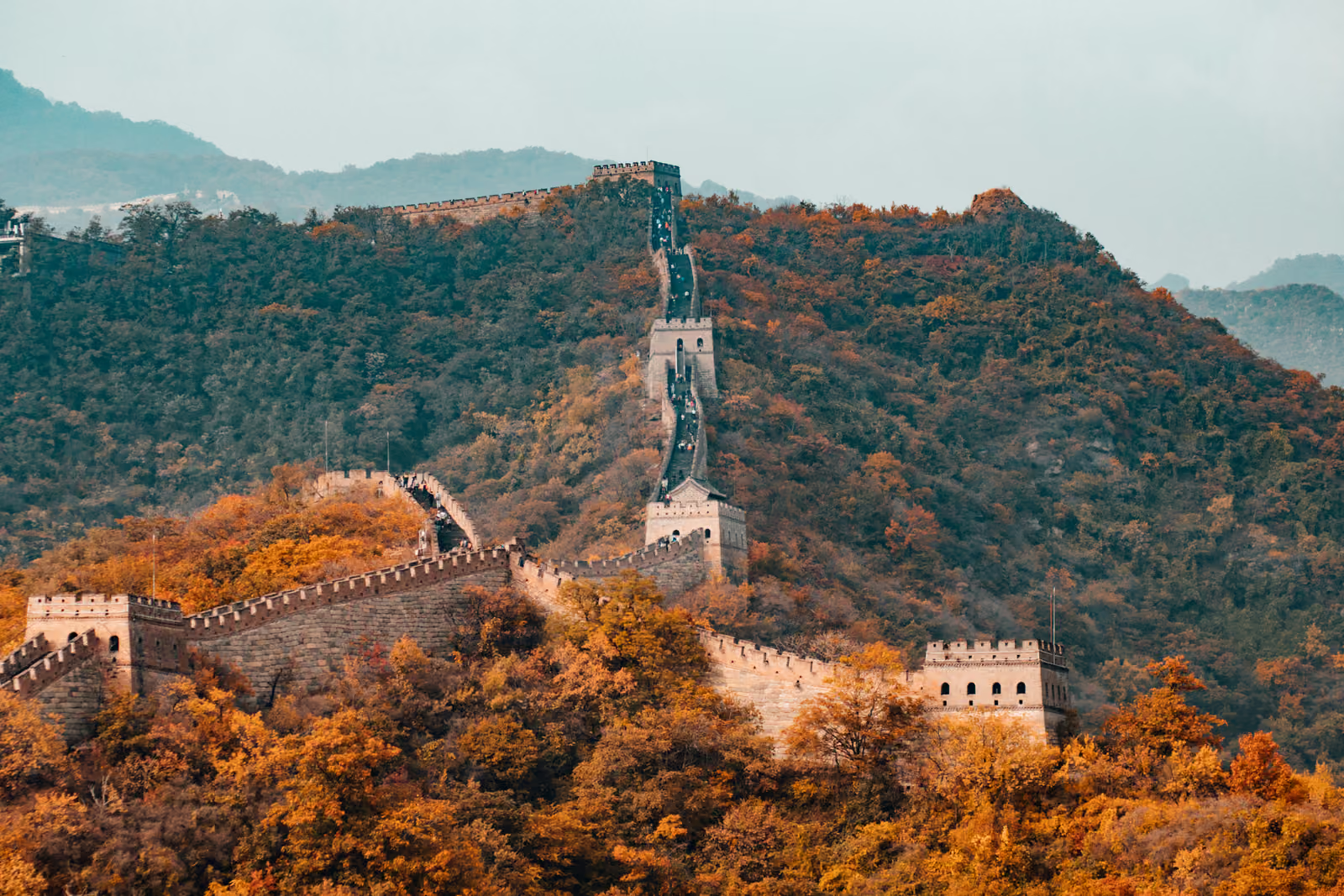
The Great Wall is not one wall — it is a series of fortification systems built over 2,000 years. The sections near Beijing were mostly rebuilt during the Ming dynasty (1368-1644) and are remarkably well preserved. Choosing the right section matters more than any other decision on this trip.
Section-by-section comparison
| Section | Distance from center | Hiking difficulty | Crowds | Restoration level | Unique features |
|---|---|---|---|---|---|
| Mutianyu | 1.5 hrs | Easy-moderate | Moderate | Fully restored | Toboggan ride down, cable car, less crowded than Badaling |
| Badaling | 1.5 hrs | Easy | Very heavy | Fully restored | Wheelchair accessible, most famous, most crowded |
| Jinshanling | 2.5 hrs | Moderate-hard | Light | Partly restored | Best hiking, watchtowers every 100m, authentic Ming wall |
| Simatai | 2.5 hrs | Hard | Very light | Unrestored | Night tours in summer, steep and wild, closest to original |
| Huanghuacheng | 1.5 hrs | Moderate | Light | Partly restored | Wall meets water (reservoir), lakeside sections |
Mutianyu: detailed guide (recommended for first-timers)
Why Mutianyu: It strikes the best balance: well restored, moderate crowds (compared to Badaling), good transport access, and unique features like the toboggan. It is the section most recommended by Beijing tour guides for good reason.
Getting there:
- Public transport: Bus 916 Express from Dongzhimen transport hub to Huairou district, then taxi (¥40) to the entrance. Total: about 2 hours, ¥30-40.
- Tourist bus: Direct from downtown Beijing (multiple departure points, 7-9am). ¥80-120 round trip.
- Private transfer: ¥400-600 round trip with waiting time. Most flexible option.
- Recommendation: Take the tourist bus or private transfer. Public transport involves transfers and is tiring after the hike.
On arrival:
- Entry: ¥40.
- Up options: Cable car (¥120 round trip or ¥100 one way), chairlift (¥100 one way), or hike up (20-30 minutes of steep steps from the base).
- Down options: Cable car, chairlift, or toboggan (¥60 one way — the most fun option).
Hiking route on the wall: From the top of the chairlift/cable car, you can walk in either direction:
- Westward (toward Tower 20-23): Less crowded, steeper, more dramatic. The wall climbs steeply with hairpin turns. This is the better hiking direction. Allow 1.5-2 hours.
- Eastward (toward Tower 1-6): Easier, more restored sections, more families. Flatter walking. Allow 1-1.5 hours.
- Full traverse: Tower 1 to Tower 23 is about 4-5 hours and 5km of steep hiking. Only for fit hikers.
The toboggan: The toboggan descends from Tower 6 to the valley floor on a concrete slide. You sit on a small plastic sled and control your speed with a brake lever. It takes about 3 minutes and is genuinely fun — one of the most memorable parts of any Great Wall visit. Take the chairlift up (Tower 6) and toboggan down for the classic Mutianyu experience.
Tips:
- Leave central Beijing by 7-8am to arrive before tour groups (which start arriving around 10am).
- Bring water (at least 1.5L) and snacks. Prices on the wall are inflated and choices are limited.
- Wear good shoes — the steps are uneven and can be slippery, especially after rain.
- Total time needed: 6-8 hours including travel from central Beijing.
- Avoid adding a major evening plan after the return — you will be tired.
Jinshanling: for hikers who want solitude
Why Jinshanling: If you want the Great Wall experience without crowds, Jinshanling is the best choice. It is 2.5 hours from Beijing but receives a fraction of Mutianyu’s visitors. The wall here is partly restored (western end) and partly wild (eastern end), giving you both safety and authenticity.
The hike:
- Enter at the west gate, walk eastward toward Simatai (about 10km, 4-5 hours).
- Watchtowers are spaced every 100-200m, offering rest stops and photography angles.
- The wall here is dramatic: steep ascents, exposed ridgelines, crumbling sections with wild vegetation growing through the bricks.
- This section has been called “the most beautiful part of the Great Wall” by Chinese hikers.
Logistics:
- Entry: ¥65.
- Transport: Bus from Wangjing West bus station to Luanping, then taxi to the wall (about 2.5 hours total, ¥60-80).
- Or hire a private driver for ¥500-700 round trip.
- Best as a full-day trip. Start by 7am.
Badaling: when accessibility matters
Badaling is the most famous and most visited section. It is fully restored, wheelchair accessible (with assistance), and has the best tourist infrastructure. But it is also the most crowded — especially on weekends and holidays, when it can feel like a theme park.
Go here if:
- You need wheelchair or stroller accessibility
- You have very limited time and want the fastest access
- You are visiting in winter when other sections may be icy or closed
Avoid if:
- You visit on a weekend or holiday (October 1-7 is extreme)
- You want a peaceful or authentic experience
- You have mobility but choose Badaling out of habit
Day 3: Temple of Heaven and hutongs
Visit the Temple of Heaven early, when the park around the monuments is alive with everyday activity. Spend the afternoon walking a hutong area at street level. These are two completely different sides of Beijing — imperial ritual and everyday life — and they reward different kinds of attention.
Temple of Heaven: architecture, acoustics, and morning rituals
The Temple of Heaven (天坛) is not a temple in the Western sense — it is a ritual complex where the emperor prayed for good harvests. Built in 1420 (Ming dynasty), it is larger than the Forbidden City (the park covers 267 hectares) but receives a fraction of the visitors. The architecture is unique in China: the circular buildings with blue tile roofs were designed to represent heaven, contrasting with the square buildings of the Forbidden City (representing earth).
The three main structures:
| Structure | Purpose | Architectural feature |
|---|---|---|
| Hall of Prayer for Good Harvests (祈年殿) | Annual prayer ceremony for good harvests | Triple-eaved circular hall, 38m tall, built entirely without nails. Blue roof tiles = heaven. |
| Echo Wall (回音壁) | Acoustic phenomenon — whispers travel along the curved wall | A circular wall 65m in diameter. Sound travels smoothly along the surface. |
| Circular Mound Altar (圜丘坛) | Winter solstice ceremony to pray to heaven | Three-tiered marble platform. The center stone produces an echo when you stand on it. |
The acoustics: The Circular Mound Altar and Echo Wall demonstrate the Ming dynasty’s sophisticated understanding of sound. Stand on the center stone of the Circular Mound and speak — your voice echoes back clearly, as if amplified. This is not a trick; it is precise geometric design. The flat marble surface reflects sound waves back to the center point. Whisper into the Echo Wall near one person, and they can hear you clearly 65 meters away — the curved surface channels sound along the wall without loss.
Morning rituals (the real attraction): The buildings are impressive, but the park’s morning life is the highlight. Arrive between 7-9am to see:
- Tai chi groups practicing in coordinated formations on the open lawns
- Ballroom dancers waltzing to portable speakers
- Card players sitting at stone tables under cypress trees
- Calligraphers writing characters on the pavement with water and large brushes (the characters evaporate after minutes — impermanent art)
- Opera singers performing excerpts from Peking Opera near the Echo Wall
- Instrument players on erhu (two-stringed fiddle), pipa (lute), and dizi (bamboo flute)
This is not a performance for tourists — it is everyday life. Join a tai chi group if invited. Ask to try the calligraphy brush. These are retired Beijing residents enjoying their morning, and they are generally happy to share the space.
Practical details:
- Tickets: ¥15 (park only), ¥34 (combined ticket including the three main structures). Get the combined ticket.
- Metro: Line 5 to Tiantandongmen station, east gate entrance.
- Time needed: 2-3 hours.
- The park is open from 6am (gates open at 8am for the main structures).
Hutong walk: understanding Beijing’s traditional neighborhoods
Hutongs (胡同) are narrow alleys lined with siheyuan (四合院) — traditional courtyard houses. Beijing once had over 6,000 hutongs; today fewer than 1,000 remain. Walking through them is the closest you get to pre-modern Beijing.
Understanding siheyuan architecture: The siheyuan is a house built around a central courtyard, with rooms on all four sides. The name literally means “four-sided courtyard.” Key features:
- Screen wall (影壁) inside the entrance — blocks evil spirits (which supposedly travel in straight lines) and provides privacy.
- Main hall (正房) faces south and receives the most light — occupied by the eldest family member.
- Wing rooms (厢房) on east and west sides — for children or secondary family.
- Opposite room (倒座房) faces north — the least desirable, used for servants or storage.
- The courtyard is the heart of the house — open to the sky, with potted plants, a fish pond, and space for family gatherings.
As you walk, look for:
- Door frames with ornate carvings — the more elaborate, the wealthier the original owner.
- Stone lions or drum-shaped door stops (门墩) outside entrances — status symbols.
- Red lanterns hanging from eaves — still a common sight.
- Grey brick walls with no windows facing the alley — privacy was paramount.
Hutong areas compared:
| Area | Character | Crowds | Best for |
|---|---|---|---|
| Nanluoguxiang | Most famous, most touristy, good for first look | High | 30-minute introduction, souvenir shopping |
| Gulou / Zhonglou area | Authentic, Drum Tower climb available, good restaurants | Moderate | Half-day walk, restaurants, rooftop views |
| Wudaoying Hutong | Quiet, good cafés, near Yonghe Temple | Low | Café hopping, peaceful walk |
| Dongsi / Beixinqiao | Residential, almost no tourists, genuine neighborhood | Very low | Authentic experience, photography |
Recommended walk: Gulou to Dongsi (2-3 hours)
- Start at Drum Tower (鼓楼, ¥35) — climb for a rooftop view over the hutong rooftops. The drum was beaten to mark time during the Ming and Qing dynasties.
- Walk east along Gulou East Street to Yonghe Temple (雍和宫, ¥25) — the best-preserved Tibetan Buddhist temple in Beijing. Originally a prince’s residence, then a lamasery. The 18-meter-tall white sandalwood Buddha in the Wanfu Pavilion is remarkable.
- Continue south through Wudaoying Hutong — quiet lane with good cafés.
- Turn south into the Dongsi area — authentic residential hutongs. Walk south on any alley between 3rd and 5th Ring Road.
- End at Dongsi subway station (Line 5) or continue to Chaoyangmen for dinner.
Hutong walking etiquette:
- Keep your voice down in residential lanes — people live behind those grey brick walls.
- Ask before photographing people or courtyards. “Keyi pai ma?” (可以拍吗?) works.
- The best hutong experiences are unstructured — put your phone away occasionally and just walk.
- Best time for photography: Late afternoon (3-5pm) for warm light on grey brick. Early morning (before 8am) for local life.
- Avoid: Organized hutong rickshaw tours that rush you through in 30 minutes. They skip the details.
Evening food near Gulou:
- Yao Ji Chaogan (姚记炒肝) — famous for fried liver and baozi (steamed buns), ¥20–40 per person. A genuine old-Beijing experience. Open since 1866.
- Pass By (过客) — rooftop restaurant near Nanluoguxiang, Chinese-Western fusion with hutong views, ¥80–150 per person.
Day 4: Summer Palace or contemporary Beijing
Choose the Summer Palace for imperial gardens and a long lakeside day. Choose the 798 Art District, Olympic Park, or contemporary Beijing if you want contrast. Trying to combine both usually produces more driving than discovery.
Summer Palace: the emperor’s escape
The Summer Palace (颐和园) was the imperial family’s retreat from the Forbidden City’s summer heat. Built around Kunming Lake with Longevity Hill as the focal point, it is the largest and best-preserved imperial garden in China (290 hectares).
What makes it different from the Forbidden City: Where the Forbidden City is about symmetry, axis, and formality, the Summer Palace is about landscape, water, and leisure. The paths wind around the lake, through gardens, and up hillsides. It feels like a park — because that is what it became after 1924.
Navigation strategy:
- Enter the north gate (via Metro Line 4, Beigongmen station), walk down Longevity Hill, cruise Kunming Lake, exit the east gate.
- Or enter the east gate (Xiyuan station), walk along the lakeside, climb Longevity Hill, exit the north gate.
- The boat cruise across Kunming Lake (¥60) is worth it — the view of the palace complex from the water is the defining experience.
Key sights inside:
- Tower of Buddhist Incense (佛香阁) — the iconic octagonal pagoda on Longevity Hill. Climb for panoramic views (extra ¥10).
- Long Corridor (长廊) — 728 meters of painted corridor along the lakeside. Over 14,000 paintings on the ceiling beams — scenes from Chinese mythology, history, and literature. Each painting is unique.
- Marble Boat (石舫) — a stone “boat” built by Empress Dowager Cixi, symbolizing the Qing dynasty’s eternal stability. Ironic, given that the dynasty collapsed 13 years after her death.
- Seventeen-Arch Bridge (十七孔桥) — connects the lakeshore to Nanhu Island. 544 stone lions on the balustrades, each in a different pose.
Practical details:
- Tickets: ¥30 peak (¥60 with combined ticket), ¥20 off season.
- Metro: Line 4 to Beigongmen station (north gate) or Xiyuan station (east gate).
- Time needed: 3-4 hours minimum.
Alternative: 798 Art District and Olympic Park
798 Art Zone (798艺术区): Contemporary art galleries in a decommissioned military factory complex. The Bauhaus-style buildings with sawtooth roofs and northern light were built in the 1950s with East German assistance. Today they house over 100 galleries, studios, cafés, and bookshops. Free entry. Allow 2-3 hours.
Olympic Park: The 2008 Olympic venues are clustered in the northern part of the city:
- Bird’s Nest (国家体育场) — the iconic stadium designed by Herzog & de Meuron. Exterior views are free; interior tours cost ¥50.
- Water Cube (now “Ice Cube” for the 2022 Winter Olympics) — adjacent to the Bird’s Nest. Now houses a water park inside.
- The area is best visited in the evening when the buildings are illuminated.
Peking Duck: restaurant comparison
Peking duck is Beijing’s signature dish, but the restaurants vary enormously in quality, price, and atmosphere.
| Restaurant | Style | Price per person | Wait time | Atmosphere |
|---|---|---|---|---|
| Quanyude (便宜坊) | Traditional, since 1416. Duck roasted in a closed oven (焖炉). | ¥150-250 | 30-60 min | Old-school, formal, tourist-friendly |
| Dadong (大董) | Modern, since 2003. Duck roasted in an open oven (挂炉). Leaner, crisper skin. | ¥300-500 | Reserve ahead | Upscale, contemporary Chinese |
| Jing Yaa Tang | Modern fusion, in the Opposite House hotel. Duck served with caviar and truffle. | ¥300-400 | Reserve ahead | Hotel dining, international |
| Siji Minfu (四季民福) | Local favorite, multiple locations. Excellent value, consistently good. | ¥100-200 | 1-2 hours (no reservations) | Casual, bustling, authentic |
| Bianyifang (便宜坊, Qianmen branch) | The original Quanyude branch near Qianmen. Same traditional style. | ¥150-250 | 30-60 min | Historic location |
What makes Peking duck different: The duck is a specific breed (Peking duck, 北京鸭), force-fed during the final weeks to create a layer of fat between the skin and meat. It is roasted until the skin is glassy and crisp. The chef carves it at the table (or in front of you) into 108 pieces — skin, meat, and skin-with-meat. You wrap each piece in a thin pancake with spring onion, cucumber, and sweet bean sauce (甜面酱). The remaining carcass is made into broth.
How to order: Ask for 一只鸭子 (yī zhī yāzi, “one duck”). It serves 2-4 people. The restaurant will bring the carved duck, pancakes, sauces, and accompaniments. Wrap your own. Start with the crispy skin dipped in sugar (a delicacy), then move to the wrapped pancakes.
Beijing cuisine beyond duck
| Dish | Chinese | What it is | Where to try | Price |
|---|---|---|---|---|
| Zhajiangmian | 炸酱面 | Noodles with fried soybean paste, shredded vegetables | Laobeijing Zhajiangmian (老北京炸酱面) | ¥20-35 |
| Jianbing | 煎饼 | Street breakfast crepe with egg and crispy cracker | Street vendors near metro stations, mornings | ¥8-15 |
| Lamb skewers | 羊肉串 | Spiced lamb on skewers, grilled over charcoal | Xinjiang restaurants in Haidian or Chaoyang | ¥5-10 each |
| Douzhir | 豆汁儿 | Fermented mung bean drink. Acquired taste. | Beijing Xiaochi (Wangfujing), Lao Maguiref (老磁器口) | ¥5-10 |
| Rolling donkey | 驴打滚 | Glutinous rice rolls coated in soybean flour and red bean paste | Snack shops, Wangfujing area | ¥5-10 |
| Tanghulu | 糖葫芦 | Candied hawthorn on a stick | Street vendors, October onwards | ¥5-10 |
| Copper pot hotpot | 涮羊肉 | Beijing-style lamb hotpot in a copper pot with charcoal | Donglaishun (东来顺, since 1854) | ¥80-150 |
Copper pot hotpot note: Beijing’s lamb hotpot (涮羊肉, shuànyángròu) is distinct from Sichuan hotpot. The copper pot has a charcoal chimney in the center, creating a ring of simmering broth around it. You dip paper-thin slices of lamb into the broth for a few seconds, then eat with sesame sauce (麻酱, májiàng), fermented tofu, and pickled garlic. Donglaishun (东来顺, est. 1854) is the classic choice. It is not spicy — the focus is on the quality of the lamb.
Photography locations in Beijing
| Location | Best shot | Best time | Notes |
|---|---|---|---|
| Jingshan Park summit | Forbidden City panorama | Late afternoon | The iconic Beijing image |
| Temple of Heaven | Hall of Prayer silhouetted against sky | Sunrise or sunset | Fewer crowds early |
| Great Wall (Mutianyu) | Wall curving over ridgeline | Morning, clear day | Go westward (Tower 15-20) for fewer people in frame |
| 798 Art District | Industrial architecture, street art | Any time | Bauhaus buildings + contemporary art |
| Hutongs near Gulou | Grey brick, red lanterns, local life | Golden hour (4-5pm) | Walk east of Nanluoguxiang for fewer tourists |
| Summer Palace | Seventeen-Arch Bridge, Tower of Buddhist Incense | Morning, from the lake | Boat position matters |
| Olympic Park | Bird’s Nest illuminated at night | After dark | Best from the south approach |
| Forbidden City moat (east side) | Ginkgo trees in autumn, reflections | October morning | From Donghuamen to Jingshan |
Daily budget breakdown
| Category | Budget (¥) | Mid-range (¥) | Comfortable (¥) |
|---|---|---|---|
| Accommodation | 200–350 | 400–700 | 800–1500 |
| Meals | 60–100 | 150–250 | 300–500 |
| Metro/taxi | 20–40 | 40–80 | 80–150 |
| Tickets/attractions | 60–100 | 100–150 | 100–200 |
| Daily total | 340–590 | 690–1180 | 1280–2350 |
For the full breakdown across a multi-city trip, the China Travel Budget guide provides per-city and per-category detail.
The useful four days
Beijing’s scale is the central planning fact. Group sights geographically, stay near a metro station, and expect security or timed entry at major attractions. Four days will not make the city feel finished; it will make the first visit feel coherent.
The imperial axis (Forbidden City, Tiananmen, Temple of Heaven) occupies two days. The Great Wall claims one. Your fourth day is flexible — Summer Palace for more imperial grandeur, 798 for contemporary contrast, or a deeper hutong exploration. The key is not to rush between distant points; Beijing rewards travelers who give each area its time.
For getting between Beijing and other cities on your trip, the high-speed train guide covers how to choose the right stations and avoid common mistakes. Before you arrive, make sure your payment setup is ready. If you are also planning where to stay in Shanghai, the same metro-proximity logic applies.
Day trips from Beijing
If your schedule allows extra days, these destinations are easily reachable from Beijing and offer distinct experiences.
Tianjin: Italy-meets-China in 30 minutes
Tianjin is a 30-minute high-speed train ride from Beijing South station (¥55, trains every 10–15 minutes). It was a foreign concession zone in the early 20th century, leaving behind Italian, French, and British colonial architecture that feels completely different from Beijing.
What to do in Tianjin:
| Attraction | Time needed | Entry fee | Notes |
|---|---|---|---|
| Five Great Avenues (五大道) | 1–2 hours | Free | European-style mansions and tree-lined streets. Rent a bike or take a horse carriage (¥80). |
| Italian Street (意大利风情区) | 1 hour | Free | Restored Italian concession area with restaurants and cafés. Touristy but photogenic. |
| Tianjin Eye (天津之眼) | 30 minutes | ¥50 | Ferris wheel built over a bridge. Go at sunset for the best views. |
| Ancient Culture Street (古文化街) | 1 hour | Free | Traditional shops, tea, and snacks. Good for souvenirs. |
| Porcelain House (瓷房子) | 30 minutes | ¥50 | A French-style building covered in ancient porcelain shards. Unique and surreal. |
Tianjin food: Tianjin is famous for street snacks, especially:
- 狗不理包子 (gǒubùlǐ bāozi) — “dogs don’t care” steamed buns, Tianjin’s most famous snack
- 耳朵眼炸糕 (ěrduoyǎn zhágāo) — fried glutinous rice cakes with red bean paste
- 十八街麻花 (shíbājiē máhuā) — twisted fried dough sticks
Sample Tianjin day trip:
- 8:00 — Depart Beijing South by high-speed train
- 8:30 — Arrive Tianjin, taxi to Five Great Avenues
- 9:00–11:00 — Explore Five Great Avenues by bike
- 11:00–12:00 — Walk Italian Street
- 12:00–13:00 — Lunch: try gǒubùlǐ bāozi and other Tianjin snacks
- 13:30–14:30 — Visit Porcelain House or Tianjin Eye
- 15:00 — Return to Beijing by train
Datong and the Yungang Grottoes: 1,500 years of Buddhist art
Datong is 2 hours from Beijing by high-speed train (¥150, multiple trains daily). The city is home to the Yungang Grottoes (云冈石窟), one of China’s three great ancient Buddhist sculptural sites — a UNESCO World Heritage site with over 51,000 statues carved into sandstone cliffs in the 5th–6th centuries AD.
Yungang Grottoes:
| Detail | Information |
|---|---|
| Entry | ¥120 |
| Time needed | 3–4 hours |
| Getting there from Datong | Bus 3 from Datong train station (¥3, 45 min), or taxi ¥50–70 |
| Best time to visit | Morning, when the light hits the eastern caves |
| What you’ll see | Caves 5–6 are the most impressive: massive Buddha statues up to 17 meters tall, intricate carvings, and colorful (restored) paintings. Caves 1–4 are smaller but atmospheric. |
Datong itinerary:
- Day 1 morning: Arrive from Beijing, visit Yungang Grottoes
- Day 1 afternoon: Return to Datong, visit Huayan Temple (华严寺, ¥80) — a Liao dynasty (907–1125) Buddhist temple with beautiful murals
- Day 1 evening: Stay overnight in Datong (hotels from ¥200–400)
- Day 2 morning: Visit the Hanging Temple (悬空寺, ¥125) — a 1,500-year-old temple built into a cliff face, 75 km from Datong (taxi ¥200)
- Day 2 afternoon: Return to Beijing by train
Is Datong worth the trip? Yes, if you are interested in ancient Buddhist art or want to see something completely different from Beijing. The Yungang Grottoes are world-class — comparable to the Ajanta Caves in India or the Bamiyan Buddhas (before their destruction). The Hanging Temple is architecturally unique. But Datong requires at least 2 days and involves significant travel time.
Chengde: the emperor’s summer retreat
Chengde is 2.5 hours from Beijing by car (or 4 hours by bus). The Mountain Resort (避暑山庄, bìshǔ shānzhuāng) is a UNESCO World Heritage site — a massive imperial garden where Qing emperors escaped Beijing’s summer heat. It is a miniature version of the Summer Palace, with Tibetan temples and gardens.
| Detail | Information |
|---|---|
| Entry | ¥130 (Mountain Resort) + ¥80 for the temples |
| Time needed | Full day |
| Getting there | Bus from Beijing Sihui Long-Distance Bus Station (¥120, 4 hours), or hire a private driver (¥500–700 one way) |
| Best time to visit | May–October, when the gardens are green and the lakes are full |
Chengde is less touristy than Beijing and offers a quieter experience of imperial China. But the travel time is significant, so it is best as an overnight trip.
Shopping in Beijing
Beijing offers distinctive shopping experiences that reflect the city’s history as a cultural and political center.
What to buy in Beijing
| Item | Where to buy | Price range | Tips |
|---|---|---|---|
| Silk products | Silk Market (秀水街, Xiùshuǐ Jiē) | ¥100–2,000 | Bargain hard — start at 30% of asking price. Scarves, pillows, clothing. Check quality carefully. |
| Tea | Mǎliandào Tea Street (马连道茶叶街) | ¥50–500 per tin | China’s tea wholesale market. Huge variety, fair prices. Taste before buying. Ask for help choosing — vendors are knowledgeable. |
| Antiques and curios | Pānjiāyuán (潘家园) weekend market | ¥20–5,000+ | China’s largest antique market. Mostly reproductions — buy for decoration, not investment. Weekend mornings are best. |
| Calligraphy and art | Liúlíchǎng (琉璃厂) culture street | ¥50–2,000 | Traditional brushes, ink, paper, and paintings. Old Beijing cultural atmosphere. |
| Pearl jewelry | Hóngqiáo (红桥) market | ¥100–3,000 | Bargain aggressively. Bring a friend who can help negotiate. |
| Beijing snacks (for gifts) | Dàodàoxiāng (稻香村) chain stores | ¥30–100 per box | Traditional Beijing pastries, well-packaged for travel. Available at train stations and airports. |
Shopping etiquette
- Bargaining: Expected at markets (Silk Market, Panjiayuan, Hongqiao) but NOT in malls or branded stores. Start at 30% of the asking price and expect to meet at 50–70%.
- Walk away: If the price is not right, walk away — sellers often call you back with a better offer.
- Check quality: Examine stitching, materials, and functionality before paying.
- Get a receipt: Ask for 收据 (shōujù) — useful if you need to return items.
Shopping districts
| Area | Best for | Vibe |
|---|---|---|
| Silk Market (Xiùshuǐ Jiē) | Silk, clothing, accessories, electronics | Bargain hunting, tourist-friendly |
| Wangfujing (王府井) | Department stores, branded goods, snacks | Modern shopping street, touristy |
| Sanlitun (三里屯) | Fashion, international brands, trendy boutiques | Young, fashionable, international |
| Panjiayuan (潘家园) | Antiques, curios, art | Weekend market, chaotic, fun |
Beijing nightlife
Beijing’s evening scene ranges from traditional tea houses to world-class cocktail bars. The city is safe at night, and public transport runs until about 10:30–11:00pm.
Where to go after dark
| Area | Vibe | Best for | Last drinks |
|---|---|---|---|
| Hòuhǎi (后海) lakeside | Bars along a scenic lake | First-time visitors, casual drinks, live music | Most bars close by midnight, some until 2am |
| Sānlǐtún (三里屯) | Trendy, international, fashion-forward | Cocktail bars, clubs, international restaurants | Clubs until 3–4am, bars until midnight–1am |
| Gǔlóu (鼓楼) / Gǔlǒuwài | Indie, alternative, hipster | Live music (MAO Livehouse, School Bar), craft beer | Bars until midnight–1am |
| Guómào (国贸) / CBD | Upscale, business-oriented | Hotel bars, rooftop cocktails with skyline views | Hotel bars until 1am |
| Wàngjīng (望京) | Korean expat district | Korean BBQ, soju bars, KTV | Late-night Korean restaurants until 2am+ |
Nightlife tips
- KTV: A popular group activity. Rooms start at ¥100–300/hour for a small room. Beer and snacks are ordered through a tablet.
- Houhai: Lakeside bars are touristy but atmospheric — good for one evening, not for serious drinking.
- Sanlitun: Has the best cocktail bars in Beijing — try rooftop bars and modern speakeasy-style venues.
- Getting home: The metro stops running around 10:30–11:00pm. After that, use Didi or a taxi.
- Safety: Beijing is generally safe at night. Well-lit streets and active nightlife in all the areas above.
Beijing air quality: what to expect and when
Beijing’s air quality varies dramatically by season and weather. Understanding the pattern helps you plan activities and pack appropriately.
Seasonal AQI patterns:
| Season | Typical AQI | Visibility | Best/worst days | What to do |
|---|---|---|---|---|
| Spring (Mar–May) | 80–150 | Moderate | Dust storms from Gobi can push AQI to 200+ for 1–2 days | Check AirVisual app daily. On high-AQI days, do indoor activities (museums, cafés) |
| Summer (Jun–Aug) | 50–100 | Good | Best air quality of the year | Outdoor activities are comfortable. Rare high-pollution days after stagnant heat |
| Autumn (Sep–Nov) | 60–120 | Good to moderate | September is clearest; November can haze | The “Golden Autumn” (September–mid-October) is the best photography window |
| Winter (Dec–Feb) | 100–250 | Poor to bad | Worst season. Heating plants burn coal; temperature inversions trap pollution | Bring an N95 mask. On AQI 200+ days, avoid outdoor exercise. Indoor attractions become more important |
Practical tips:
- Download the AirVisual app before arrival — it provides real-time AQI data and forecasts for Beijing. The built-in iPhone weather app also shows AQI.
- Buy masks locally: 3M N95 masks are available at pharmacies (药店, yàodiàn) for ¥15–25 per box of 5. Much cheaper than importing.
- Air purifiers in hotels: Most mid-range and above hotels have air purifiers or central filtration. Check reviews for “air purifier” mentions. Budget hotels may not — bring a portable one if sensitive.
- The Great Wall is not always cleaner: Counterintuitively, the Great Wall sections near Beijing (Mutianyu, Badaling) can have similar AQI to the city on bad days, because pollution spreads across the whole region. However, wind direction matters — if wind blows from the northwest, mountain sections are significantly cleaner.
- Indoor alternatives on bad air days: National Museum of China (free, 2–3 hours), Capital Museum (free, excellent Beijing history), 798 Art District (galleries are indoors), shopping at Silk Market or Sanlitun.
Beijing’s air quality trend: Air quality has improved significantly since 2013–2014 (when AQI regularly exceeded 300). The government’s coal-to-gas conversion and industrial relocation have reduced average winter AQI by roughly 40%. However, winter remains the worst season, and occasional high-pollution events still occur. Spring dust storms from Mongolia are a separate issue — they bring visible yellow dust and push AQI to 200+ for 1–3 days.
Beijing dialect: understanding the local flavor
Beijing Mandarin (北京话, Běijīnghuà) is the basis for Standard Chinese (普通话, pǔtōnghuà), but the local dialect has distinctive features. Understanding a few patterns helps you sound more natural and understand locals better.
The erhua (儿化) phenomenon:
Beijingers add an “-r” sound (儿, ér) to the end of many words. This is not random — it follows patterns:
| Standard Mandarin | Beijing dialect | Pronunciation | Meaning | When you’ll hear it |
|---|---|---|---|---|
| 这儿 (zhèr) | 这儿 (zhèr) | “jèr” | Here | Taxi drivers: “就在这儿” (right here) |
| 那儿 (nàr) | 那儿 (nàr) | “nàr” | There | Directions: “在那儿拐” (turn there) |
| 一点儿 (yìdiǎnr) | 一点儿 (yìdiǎnr) | “yìdiǎr” | A little bit | Bargaining: “便宜一点儿” (a bit cheaper) |
| 胡同 (hútòng) | 胡同儿 (hútòngr) | “hútòngr” | Hutong alley | “这个胡同儿” (this hutong) |
| 玩 (wán) | 玩儿 (wánr) | “wánr” | To play/hang out | “去哪儿玩儿?” (where are you going?) |
| 好吃 (hǎochī) | 好吃儿 (hǎochīr) — rare | — | Delicious | Usually just 好吃, but some add 儿 for emphasis |
You don’t need to speak Beijing dialect — Standard Mandarin (普通话) works everywhere. But recognizing erhua helps you understand when locals are speaking. If someone says “zhèr” instead of “zhèlǐ” (here), they are using Beijing erhua.
Useful Beijing-specific expressions:
| Expression | Pinyin | Meaning | Context |
|---|---|---|---|
| 得嘞 (délei) | délei | “Got it!” / “OK!” | Taxi drivers, shopkeepers use this constantly. It means “understood, will do.” |
| 您 (nín) | nín | You (polite) | Beijingers use 您 instead of 你 (nǐ) as a sign of respect. You’ll hear it everywhere. Using 您 back earns a nod of approval. |
| 劳驾 (láojià) | láojià | “Excuse me” / “Pardon” | More Beijing than 对不起. Use when squeezing past someone on the subway or getting a waiter’s attention. |
| 吃了么 (chī le me) | chī le me | “Have you eaten?” | A greeting, not a literal question. Respond with “吃了” (chī le, “yes, I ate”) even if you haven’t. |
| 嘛呢 (má ne) | má ne | “What’s up?” / “What are you doing?” | Casual Beijing greeting among friends. Not for formal situations. |
The Beijing tone: Beijing speakers tend to speak faster and with more “swallowed” syllables than the careful pronunciation in textbooks. The fourth tone (falling) is especially sharp in Beijing. Don’t worry if you can’t follow everything — context and gestures carry most conversations.
Beijing crowd calendar: when to go for each attraction
Beijing’s attractions have wildly different crowd levels depending on the day and season. Use this calendar to plan your visit.
Monthly crowd levels:
| Month | Overall crowd level | Notes | Best attractions this month |
|---|---|---|---|
| January | Low | Cold (-5 to 5°C), but after New Year’s Day it quiets down. Chinese New Year (late Jan/early Feb) brings 1 week of closures and chaos | Forbidden City (quiet), Great Wall (almost empty on weekdays), Temple of Heaven |
| February | Low to moderate | Chinese New Year (dates vary, check lunar calendar) disrupts everything for ~1 week. After CNY, crowds are low | Same as January. Avoid the week of CNY entirely |
| March | Low to moderate | Weather warms, spring begins. Weekdays are quiet | All attractions. Cherry blossoms start in late March at Yuyuantan Park (free) |
| April | Moderate | Spring break for schools (early April). Cherry blossom season | Forbidden City, Summer Palace (peach blossoms), Yuyuantan Park |
| May | Moderate to high | Labor Day holiday (May 1–5) is extreme. After Labor Day, moderate | Avoid May 1–5. Otherwise good weather, all attractions |
| June | Moderate | School exams (gaokao, June 7–8) mean some domestic travel disruption. Hot (30°C+) | Great Wall (early morning), Temple of Heaven (early, before heat) |
| July | High | Summer vacation begins. Families travel. Hot and humid | All attractions are crowded. Go early (before 8am) or late (after 4pm) |
| August | High | Peak summer crowds. Hot (35°C+) | Same as July. Consider Jinshanling Great Wall (much quieter than Mutianyu) |
| September | Moderate to low | Best month. Weather cools, crowds thin after summer. Air quality improves | All attractions. Photography is excellent |
| October | Low to moderate | National Day Golden Week (Oct 1–7) is the worst week of the year. After Oct 7, crowds drop sharply | Avoid Oct 1–7. Mid-October to November is ideal |
| November | Low | Weather turns cold. Leaves change color at Summer Palace and Fragrant Hills | Forbidden City (quiet), Great Wall (dramatic with autumn colors), Fragrant Hills (红叶, red leaves) |
| December | Low | Cold, dry, some pollution. Very quiet except for New Year’s Eve | Forbidden City (snow-covered is magical if you’re lucky), Great Wall (stark beauty) |
Key dates to avoid entirely:
- Chinese New Year (春节, Chūn Jié): Dates vary (late January to mid-February). Most attractions close or operate on reduced hours. Transportation is overwhelmed. Not recommended.
- Labor Day (五一, Wǔ Yī): May 1–5. Major domestic travel holiday. Attractions are packed, hotels surge 50–100%.
- National Day Golden Week (国庆, Guó Qìng): October 1–7. The single worst time to visit Beijing. The Forbidden City sells out days in advance. The Great Wall becomes a human conveyor belt.
- School summer vacation (July 15 – August 25): Family travel season. Attractions are crowded but not as extreme as Golden Weeks.
Weekday vs weekend patterns:
- Forbidden City: Weekdays are 30–50% less crowded than weekends. Tuesday–Thursday are the quietest. Monday closures mean Tuesday gets a slight surge from displaced weekend visitors.
- Great Wall (Mutianyu): Weekends bring tour buses. Tuesday–Thursday are quietest. Saturday is the worst.
- Temple of Heaven: Weekday mornings (7–9am) have the most local activity (tai chi, calligraphy). Weekend mornings are more touristy.
- Summer Palace: Weekdays in September–October are ideal. Weekends in summer are crowded with local families.
Hourly patterns:
- Forbidden City: Least crowded 1–3pm (lunch dip). Most crowded 9–11am (tour groups arrive).
- Great Wall: Least crowded before 9am and after 3pm. Tour groups arrive 10am–2pm.
- Temple of Heaven: Best before 9am (local activities, fewer tourists). After 11am, tour groups arrive.
- Hutongs (Gulou area): Best in early morning (before 8am) or late afternoon (4–5pm). Midday is quiet because people are indoors (good for photography, less for atmosphere).
Beijing metro: line-by-line attraction guide
Beijing’s metro system has 27 lines and over 400 stations. Here is which metro lines serve which attractions — plan your hotel location around the lines you’ll use most.
Key lines for tourists:
| Line | Color | Major tourist stations | Notes |
|---|---|---|---|
| Line 1 | Red | Tian’anmen West (天安门西), Tian’anmen East (天安门东), Wangfujing (王府井) | Runs east-west through the center. Connects Tiananmen, Forbidden City (south side), and Wangfujing shopping |
| Line 2 | Dark blue | Qianmen (前门), Chongwenmen (崇文门), Jianguomen (建国门), Dongzhimen (东直门) | Loop line around the old city. Connects Qianmen (south of Tiananmen), Lama Temple area |
| Line 4 | Cyan | Beigongmen (北宫门, Summer Palace north gate), Xiyuan (西苑, Summer Palace east), Beijing South Railway Station (北京南站) | North-south line. Essential for Summer Palace and high-speed train connections |
| Line 5 | Purple | Tiantandongmen (天坛东门, Temple of Heaven east gate), Dongsi (东四), Songjiazhuang (宋家庄) | North-south line. Direct to Temple of Heaven |
| Line 8 | Green | Gulou (鼓楼, Drum Tower), Nanluoguxiang (南锣鼓巷), Olympic Park (奥林匹克公园) | North-south line through hutong area and Olympic Park |
| Line 10 | Light blue | Jintaihuizhaojie (金台夕照, CBD), Hujialou (呼家楼), Liangmaqiao (亮马桥, embassy area) | Loop line in the east. CBD, embassy district, Sanlitun area (walk from Tuanjiehu or Liangmaqiao stations) |
| Line 13 | Yellow | Wangjing West (望京西), Huilongguan (回龙观), Dongzhimen (东直门) | Suburban line. Useful for airport express connection at Dongzhimen |
| Airport Express | — | Sanyuanqiao (三元里), Dongzhimen (东直门), Terminal 2, Terminal 3 | Separate ticket (¥25). Connects downtown to Capital Airport (PEK) in ~20 min from Dongzhimen |
Metro navigation tips:
- Metro map: Download the official Beijing Metro app or use Baidu Maps. The physical metro map at each station is in Chinese and English.
- Transfers: Major transfer stations: Xidan (Lines 1 & 4), Dongdan (Lines 1 & 5), Dongzhimen (Lines 2, 13 & Airport Express), Songjiazhuang (Lines 5, 10 & Yizhuang Line).
- Rush hours: 7:30–9:00am and 5:30–7:30pm on weekdays. Lines 1, 4, 5, and 10 are extremely crowded. Avoid if possible, or stand at the far end of the platform where fewer people queue.
- Security check: Every station has a security checkpoint (bag scan). Allow 1–2 minutes. Keep your bag accessible.
- Metro vs taxi: For distances under 5km during rush hour, metro is faster. For distances over 10km or when carrying luggage, taxi/Didi is more comfortable.
- Last trains: Usually around 10:30–11:00pm (varies by line). Check the last train time at your departure station. After last train, taxis are available but expect queues at popular stations.
Buying metro tickets:
- Single-ride tickets: Buy at machines (English interface available). Insert cash or scan Alipay/WeChat QR code.
- Alipay transit QR code: The most convenient option. Open Alipay → Transport → select Beijing → show QR code at the gate. No deposit, no refills.
- Yikatong (一卡通) card: A reloadable metro card. ¥20 deposit + recharge. Available at most stations. Useful if you don’t have Alipay set up yet — but Alipay is easier.
- Apple Pay: Not accepted for metro entry. Use Alipay transit QR code instead.
Seasonal highlights: what makes each season unique
Beijing has four distinct seasons, each with attractions and experiences you cannot get at other times of year.
Spring (March–May): Blossoms and renewal
- Cherry blossoms (樱花, yīnghuā): Yuyuantan Park (玉渊潭公园, free, late March–mid-April) is Beijing’s most famous cherry blossom spot. The early varieties bloom first, then the late varieties 1–2 weeks later. Go on a weekday morning to avoid crowds.
- Peach blossoms (桃花, táohuā): Summer Palace’s west side and the Agricultural Exhibition Center (late March–April).
- Magnolias (玉兰, yùlán): The Forbidden City’s Imperial Garden has magnolia trees that bloom in early April. The contrast of white flowers against red walls is iconic.
- Sandstorms: Occasional dust storms from the Gobi Desert (March–April) bring yellow haze for 1–3 days. Check air quality forecasts.
Summer (June–August): Heat, lotuses, and nightlife
- Lotus flowers (荷花, héhuā): Beihai Park (北海公园) and Zizhu Park (紫竹院公园) have lotus ponds in full bloom July–August. Early morning is the best viewing time.
- Summer Palace lake: Kunming Lake is most beautiful in summer when the lotuses bloom and the willows are full. The boat cruise is refreshing on hot days.
- Night markets: Summer brings outdoor night markets and street food stalls. Wangfujing Snack Street is touristy but atmospheric. Guijie (簋街, Ghost Street) is the local favorite for late-night spicy crayfish (小龙虾, xiǎolóngxiā).
- Avoid: July–August is hot (35°C+) and humid. Outdoor activities should be scheduled for early morning (before 10am) or evening (after 5pm).
Autumn (September–November): Golden ginkgo and red leaves
- Ginkgo trees (银杏, yínxìng): Beijing’s ginkgo trees turn brilliant gold in late October–early November. Best spots:
- Inside the Forbidden City (east side of the moat, from Donghuamen to Jingshan)
- Ditan Park (地坛公园, free, late October)
- Guozijian (国子监, Imperial Academy, ¥30) — ancient ginkgo trees over 300 years old
- Olympic Forest Park (奥林匹克森林公园, free, late October)
- Fragrant Hills red leaves (香山红叶, Xiāngshān hóngyè): The most famous autumn foliage spot in Beijing. The maples turn red in mid-October–early November. Take bus 318 or 331 from the city. Go on a weekday — weekends are extremely crowded.
- Best photography window: September 20–October 20 offers the clearest skies, warmest light, and most comfortable temperatures. This is the peak season for a reason.
Winter (December–February): Snow, ice, and hotpot
- Snow on the Forbidden City: If you’re lucky enough to visit during a snowfall, the Forbidden City’s golden roofs under white snow are the most magical sight in Beijing. Snow is not common (maybe 2–3 times per winter), but when it happens, the palace is unforgettable.
- Shichahai ice skating (什刹海冰场): In winter, the lakes at Shichahai (near Houhai) freeze over and become natural ice skating rinks (¥50–100, January–February). Rent skates or bring your own. A unique Beijing winter experience.
- Temple of Heaven winter atmosphere: Fewer tourists in winter means you can experience the park’s morning activities (tai chi, calligraphy) without crowds. The cypress trees are dark green against grey skies — atmospheric.
- Hotpot season: Winter is the season for copper pot lamb hotpot (涮羊肉, shuànyángròu). Donglaishun (东来顺) is the classic choice. The charcoal-heated copper pot is especially comforting on a cold day.
- Temperatures: December–February averages -5 to 5°C, with occasional drops to -10°C. Bring warm layers, gloves, and a hat. The Great Wall is very cold and windy — dress accordingly.
Beijing’s living culture: traditional performances
Beijing is the birthplace of Peking Opera and remains China’s center for traditional performing arts. Seeing a live performance is one of the most memorable things you can do in the city — and it fills an evening that might otherwise go to another bar.
Peking Opera (京剧, Jīngjù)
Peking Opera is not opera in the Western sense. It is a total art form combining singing, dialogue, acrobatics, martial arts, dance, and elaborate costume — all governed by conventions that are over 200 years old. The stories come from Chinese history, mythology, and literature (Romance of the Three Kingdoms, Journey to the West, Water Margin). Every gesture has meaning: a sleeve flicked outward means anger; a hand raised to the forehead means thinking; a character walking in a circle has traveled a great distance.
The four roles:
| Role type | Chinese | What they play | Distinguishing feature |
|---|---|---|---|
| Sheng (生) | Male lead | Scholar-officials, warriors, emperors | Plain painted face (or none). Singing voice is natural. |
| Dan (旦) | Female lead | Virtuous women, warriors, immortals | Elaborate headdress and makeup. High-pitched falsetto voice. |
| Jing (净) | Painted face | Powerful, rough, or supernatural characters | Bold face paint — red (loyalty), black (honesty), white (treachery), blue (ferocity). |
| Chou (丑) | Clown | Comic relief, tricksters, servants | White patch over nose and eyes. Acrobatic and improvisational. |
Where to see it:
| Venue | Price | Experience | Notes |
|---|---|---|---|
| Lao She Tea House (老舍茶馆) | ¥100–280 (includes tea and snacks) | Tourist-friendly, abbreviated performances, English subtitles | Qianmen area. Good first introduction. Performances combine opera, acrobatics, face-changing. 1–1.5 hours. |
| Chang’an Grand Theatre (长安大戏院) | ¥80–580 | Serious venue, full-length operas, some English subtitles | East of Wangfujing. Where Beijing opera locals go. Check schedule in advance — runs 2–3 hours. |
| Huguang Guild Hall (湖广会馆) | ¥180–380 | Historic venue (since 1807), atmospheric, dinner available | Near Caishikou. Sun Yat-sen founded the Kuomintang here in 1912. The wooden stage and galleries are worth the visit alone. |
| Liyuan Theatre (梨园剧场) | ¥180–360 | Purpose-built for tourists, 1-hour highlights show | In Qianmen area. The most accessible option for first-timers. Includes costume photo opportunity. |
Tips for first-timers:
- You do not need to understand Chinese to enjoy it. The costumes, acrobatics, and music are visually spectacular even without context.
- Read the synopsis beforehand — most programs or websites list the evening’s performance with a brief summary.
- Arrive 15 minutes early. Latecomers are not seated until intermission.
- Photography is generally allowed (no flash), but be discreet.
- The best introduction is a highlights show (1–1.5 hours) rather than a full-length opera (2–3 hours of dense singing in classical Chinese).
Acrobatics and kung fu shows
Beijing has several venues for Chinese acrobatics — a tradition stretching back over 2,000 years. The performances are family-friendly and visually stunning.
| Venue | Show | Price | Duration |
|---|---|---|---|
| Chaoyang Theatre (朝阳剧场) | Peking Acrobatics | ¥100–280 | 1.5 hours |
| Red Theatre (红剧场) | Kung Fu show (Shaolin monks) | ¥180–580 | 1 hour |
| Beijing Theatre (北京剧场) | Various acrobatic performances | ¥100–280 | 1.5 hours |
The Red Theatre’s kung fu show tells the story of a young boy who enters a Shaolin monastery — the monks perform extraordinary feats including iron body techniques, weapon routines, and group choreography. It is one of Beijing’s most popular evening shows for good reason.
Tea house performances
Beijing’s tea houses combine tea culture with live entertainment in an intimate setting. This is the most relaxed way to experience traditional performance.
Lao She Tea House (老舍茶馆) is the most famous — named after the novelist who wrote “Teahouse” (茶馆), a play set in a Beijing tea house across three political eras. The multi-story building near Qianmen serves Beijing snacks and jasmine tea while hosting rotating performances: Peking Opera excerpts, face-changing (川剧变脸), shadow puppetry, erhu solos, and acrobatics. Go for the 7:30pm show.
Zhengyi Temple Teahouse (正乙祠戏楼) — China’s oldest surviving private theatre (built 1688, Qing dynasty). An intimate wooden hall where you can watch Kunqu opera (昆曲, one of the oldest forms of Chinese opera, predating Peking Opera by 300 years) while drinking tea. A rare chance to see the art form that Peking Opera grew from.
Beijing beyond the main sights: additional temples and parks
The Forbidden City, Temple of Heaven, and Summer Palace absorb most visitors, but Beijing has dozens of other temples, parks, and gardens that are less crowded and often more atmospheric.
Temples worth visiting
| Temple | Entry | Time needed | Why go | Metro |
|---|---|---|---|---|
| Lama Temple (雍和宫, Yōnghé Gōng) | ¥25 | 1.5–2 hours | Beijing’s best-preserved Tibetan Buddhist temple. Originally a prince’s palace (1694), converted to a lamasery in 1744. The 18-meter sandalwood Buddha in the Wanfu Pavilion (万福阁) is carved from a single tree trunk — brought from Nepal in the 18th century. Incense smoke fills every hall; pilgrims prostrate themselves on the marble. The most active and atmospheric temple in Beijing. | Line 2 or Line 5, Yonghegong station |
| Confucius Temple (孔庙, Kǒng Miào) | ¥30 (combined with Guozijian) | 1–1.5 hours | Dedicated to Confucius (551–479 BC). The courtyard holds 198 stone tablets inscribed with the names of 51,624 successful imperial examination candidates spanning 800 years. Ancient cypress trees over 700 years old. Peaceful and scholarly atmosphere. Adjacent to the Imperial Academy. | Line 2 or Line 5, Yonghegong station (5-minute walk) |
| Guozijian (国子监, Imperial Academy) | ¥30 (combined) | 1 hour | China’s highest institution of learning during the Yuan, Ming, and Qing dynasties (1306–1911). The Biyong (辟雍) hall sits on a circular moat — the emperor lectured here. Ancient ginkgo trees turn gold in late October. | Same as Confucius Temple |
| White Cloud Temple (白云观, Báiyún Guàn) | ¥10 | 1–1.5 hours | The most important Taoist temple in northern China. Headquarters of the Quanzhen (Complete Perfection) sect. During the Spring Festival (January–February), the temple fair (庙会) is one of Beijing’s most colorful folk events — fortune-tellers, paper-cutting artists, traditional snacks, and pilgrims seeking blessings. Far from tourist routes. | Line 7, Guang’anmennei station (10-minute walk) |
| Tanzhe Temple (潭柘寺, Tánzhè Sì) | ¥55 | 2–3 hours | Beijing’s oldest Buddhist temple, founded in 307 AD (Jin dynasty). Set in a forested mountain valley 30km west of the city. The ancient ginkgo trees, pine-covered courtyards, and Ming dynasty murals make it one of the most atmospheric temples near Beijing. Combine with a visit to the nearby Ming Tombs. | No direct metro. Bus or taxi from the city (1 hour). Best as a half-day trip. |
Parks for locals and photographers
| Park | Entry | Best for | Notes |
|---|---|---|---|
| Beihai Park (北海公园) | ¥10 | Classic Chinese gardens, the White Dagoba (白塔, 1651), boating on the lake | One of the oldest surviving imperial gardens (built 1166, Jin dynasty). The White Dagoba was built by a Tibetan Buddhist lama for the Shunzhi Emperor. The Nine-Dragon Wall (九龙壁) — a glazed ceramic wall with nine writhing dragons — is one of only three in China. |
| Jingshan Park (景山公园) | ¥10 | The Forbidden City panorama | Already covered above — the summit pavilion offers Beijing’s single best view. Go at sunset. |
| Ritan Park (日坛公园) | Free | Quiet morning walks, local tai chi groups | The Altar of the Sun, where Ming and Qing emperors performed sunrise rituals. Now a peaceful neighborhood park. The Korean-style pavilion reflects the historical tributary relationship. |
| Zhongshan Park (中山公园) | ¥3 | Ancient trees, the Well of Chaste Maiden, tulip festival in April | Immediately west of Tiananmen. Named after Sun Yat-sen. The “Defensive War Against the Eight-Nation Alliance” monument is here. The hundreds of old cypress and cryptomeria trees are over 500 years old. |
| Yuyuantan Park (玉渊潭公园) | ¥10 | Cherry blossoms (late March–mid-April), lakeside walking | Beijing’s most popular cherry blossom spot. Over 2,000 cherry trees in 20+ varieties. The early blooms (late March) and late blooms (mid-April) create a 3-week window. Go on a weekday morning. |
| Olympic Forest Park (奥林匹克森林公园) | Free | Running, cycling, autumn ginkgo | 680 hectares — Beijing’s largest green space. The north park is wilder and quieter; the south park has more facilities. In late October, the ginkgo avenue turns gold. Locals jog, practice tai chi, and fly kites here. |
| Fragrant Hills (香山, Xiāngshān) | ¥10 (peak season ¥5) | Autumn red leaves (mid-October–early November) | The maples turn brilliant red. Take bus 318 or 331 from the city. Weekdays only — weekends are overwhelmed. The hike to the summit (557m) takes 1–1.5 hours. |
Beijing museums: beyond the National Museum
Beijing has over 170 museums — more than any other city in China. Beyond the obvious (National Museum, Palace Museum), here are the ones that deserve your time.
| Museum | Entry | Time needed | Highlights | Metro |
|---|---|---|---|---|
| Capital Museum (首都博物馆) | Free (reservation required) | 2–3 hours | Beijing’s history from prehistory to present. The bronze gallery is outstanding. Excellent English labels. Far fewer tourists than the National Museum. | Line 1, Muxidi station |
| Military Museum of the Chinese People’s Revolution (中国人民革命军事博物馆) | Free (reservation required) | 2–3 hours | Tanks, missiles, aircraft, and swords across five floors. The Korean War and Vietnam War galleries offer perspectives you will not find in Western museums. Children love it. | Line 1 or Line 9, Military Museum station |
| Beijing Natural History Museum (北京自然博物馆) | ¥15 (dinosaur hall extra) | 2 hours | Dinosaur fossils, a giant panda exhibit, and a surprisingly good taxidermy collection. Good for families with children. | Line 8, Tianqiao station (10-minute walk) |
| China Science and Technology Museum (中国科学技术馆) | ¥30–60 | 3–4 hours | Five floors of interactive exhibits. The IMAX dome screen is one of Beijing’s largest. Excellent for children and teenagers. | Line 8, Olympic Park station |
| Beijing Ancient Observatory (北京古观象台) | ¥20 | 1 hour | Eight bronze astronomical instruments from the 15th–17th centuries (Ming dynasty), mounted on a 14-meter-high brick platform. Some were designed by Jesuit missionaries (Ferdinand Verbiest, 1669). Small but unique. | Line 1 or Line 2, Jianguomen station |
| 798 Art District | Free (individual galleries may charge) | 2–3 hours | Covered in Day 4 — but worth emphasizing as a museum-level experience. The Bauhaus factory buildings are as striking as the art inside. | Line 14, Wangjing South station (15-minute walk) or taxi |
| Today Art Museum (今日美术馆) | ¥20–50 | 1–1.5 hours | Beijing’s most important contemporary art museum. Rotating exhibitions of Chinese and international contemporary art. | Line 10, Shuangjing station (10-minute walk) |
| Ullens Center for Contemporary Art (UCCA尤伦斯) | ¥30–100 | 1–2 hours | Major international and Chinese contemporary art. In the 798 district. Worth visiting for the exhibitions alone. | Same as 798 |
Museum tips:
- Most museums are closed on Mondays.
- Free museums require advance reservation via their WeChat mini-programs or websites. Bring your passport.
- Security checks at entrance (bag scan).
- Photography is usually allowed (no flash, no tripods). Some exhibitions prohibit photography entirely — look for signs.
- Allow 2–3 hours for most museums. The Military Museum and Science Museum can fill a full day.
Beijing tea culture: where to drink, buy, and learn
Tea is not just a drink in Beijing — it is a social ritual, a medical tradition, and an art form. The city sits at the intersection of northern China’s tea-drinking culture and the ancient trade routes that brought tea from the south.
Tea house experiences
| Tea house | Price | Experience | Notes |
|---|---|---|---|
| Lao She Tea House (老舍茶馆) | ¥100–280 | Performance + tea + snacks | Covered above — the tourist-friendly introduction to tea house culture. |
| Biqing Teahouse (碧清茶馆) | ¥60–120 per person | Quiet, traditional, no performance | Near Gulou. Wooden furniture, clay teapots, a selection of 20+ teas. The owner explains each tea’s origin and brewing method. A genuine tea experience without the tourist polish. |
| Tenfu Tea (天福茗茶) chain stores | ¥30–100 per person | Modern chain, consistent quality | Multiple locations in Beijing. Good for a reliable cup and for buying tea as gifts. Staff speak some English. |
Mǎliandào Tea Street (马连道茶叶街): Beijing’s tea market
Mǎliandào is China’s largest tea wholesale market — a kilometer-long street lined with hundreds of tea shops, each selling tea from a different region. This is where Beijing locals come to buy tea for daily drinking and for gifts.
How to shop here:
- Vendors will invite you to sit down, taste teas, and talk. This is not aggressive salesmanship — it is tea culture. Accept the tea, ask questions, and take your time.
- Ask for 茉莉花茶 (mòlìhuā chá, jasmine tea) — Beijing’s signature tea. The jasmine scent comes from layering tea leaves with fresh jasmine blossoms over several nights. Beijing drinkers have preferred jasmine tea for centuries because the city’s water was historically hard and alkaline — the floral scent masked the water’s taste.
- Popular gifts: 铁观音 (Tiěguānyīn, oolong from Fujian), 龙井 (Lóngjǐng, green tea from Hangzhou), 普洱 (Pǔ’ěr, aged tea from Yunnan), 大红袍 (Dà Hóng Páo, “Big Red Robe” — the most expensive rock tea from Wuyi Mountain).
- Price range: ¥50–500 per tin (100g–250g). High-end teas (aged Pǔ’ěr, authentic Dà Hóng Páo) can cost thousands.
- Bargaining is expected — start at 50% of the asking price.
Tips:
- Taste before buying. Every shop will let you sample.
- Ask about the year of harvest — green tea should be from the current year (spring harvest is best); Pǔ’ěr improves with age.
- Ask for 真空包装 (zhēnkōng bāozhuāng, vacuum-sealed packaging) if you are traveling — it keeps tea fresh and passes through airport security easily.
- Take a taxi — the area is not metro-accessible (nearest is Line 7, Wanzi station, then 15-minute walk).
Beijing with kids: family-friendly activities
Beijing works surprisingly well for families. The city is safe, the metro is easy to navigate, and children are welcomed almost everywhere. Here are the best activities by age group.
Ages 3–7: young children
| Activity | Entry | Time needed | Why kids love it |
|---|---|---|---|
| Beijing Zoo (北京动物园) | ¥15 (panda hall extra ¥5) | 2–3 hours | Giant pandas are the star attraction. The zoo also has golden monkeys, snow leopards, and red pandas. Go early (before 10am) when pandas are active — they sleep most of the afternoon. Metro Line 4, Dongwuyuan station. |
| Beijing Aquarium (北京海洋馆) | ¥168 (combined with zoo) | 2–3 hours | One of Asia’s largest indoor aquariums. Dolphin and sea lion shows. Located inside the zoo compound. |
| Toboggan at Mutianyu Great Wall | ¥60 one-way | Included in Great Wall day | The 3-minute ride down a concrete track is the highlight of any family’s Beijing trip. Children over 3 can ride with a parent; older kids ride alone. |
| Summer Palace boat cruise | ¥60 | 30 minutes | Children enjoy being on the water. The views of the palace complex from the lake are impressive for all ages. |
| Science and Technology Museum | ¥30–60 | 3–4 hours | Interactive exhibits, the IMAX dome, and hands-on experiments. A full day for curious children. |
Ages 8–14: school-age
| Activity | Entry | Time needed | Why kids love it |
|---|---|---|---|
| Great Wall hike (Mutianyu or Jinshanling) | ¥40–65 | Full day | Older children can handle the steps. The watchtowers feel like castle forts. Pack snacks and plenty of water. |
| Cycling on the Forbidden City moat | Free (bring your own bike or rent nearby) | 1 hour | The path along the east side of the moat is flat, scenic, and car-free. Good after the palace visit when kids need to move. |
| 798 Art District | Free | 2 hours | Street art, sculptures, and weird installations spark imagination. Some galleries are interactive. |
| Military Museum | Free | 2–3 hours | Real tanks, missiles, and fighter jets. Interactive military history. |
| Beijing Hutong bike tour | ¥100–200 for guided tour | 2–3 hours | Several companies offer family-friendly hutong bike tours. Children enjoy riding through the narrow lanes and seeing the old neighborhoods. |
Practical tips for families:
- Strollers: The Forbidden City and Temple of Heaven are stroller-friendly (flat ground). The Great Wall is not. Leave strollers at the hotel for the Great Wall day.
- Children’s tickets: Most attractions offer free entry for children under 1.2m and half-price for 1.2–1.4m. Bring passports as proof of age.
- Food: Beijing cuisine is not spicy (unlike Sichuan). Noodles, dumplings, pancakes, and rice are all available everywhere. Children eat well in Beijing.
- Metro with kids: Avoid rush hours (7:30–9am, 5:30–7:30pm). The metro is stroller-accessible at most stations (look for the elevator symbol).
- Bathrooms: Changing tables are rare in public restrooms. Carry a portable changing mat if needed.
Beijing hidden gems: lesser-known but worthwhile
These spots are off the standard tourist route but offer genuine Beijing experiences.
| Spot | Entry | Time needed | What makes it special | Metro |
|---|---|---|---|---|
| Fahai Temple (法海寺) | ¥20 | 1 hour | Ming dynasty murals (1443 AD) that are among the finest surviving Buddhist paintings in China. The figures — bodhisattvas, animals, clouds — are painted with extraordinary detail, including gold-thread technique. Viewings are timed (small groups, 30 min slots) to protect the murals. Far from tourist routes. | Line 1, Pingguoyuan station + taxi (15 min) |
| Beijing Ancient Observatory | ¥20 | 1 hour | Eight 15th-century bronze astronomical instruments on a Ming dynasty platform. Designed by Chinese and Jesuit astronomers. Small but unique. | Line 1, Jianguomen station |
| Confucius Temple + Guozijian | ¥30 combined | 1.5–2 hours | 700-year-old cypress trees, 198 imperial examination stone tablets, the Biyong lecture hall on a circular moat. Peaceful and scholarly. | Line 2/5, Yonghegong station |
| Zhihua Temple (智化寺) | ¥20 | 45 minutes | A 1444 Ming dynasty temple with the country’s oldest surviving wooden ceiling (coffered, carved with dragons). Daily music performances using 28 instruments from a 560-year-old tradition. Hidden in a residential lane near Chaoyangmen. | Line 2, Chaoyangmen station |
| Ming Dynasty City Relic Park (明城墙遗址公园) | Free | 30 minutes | A 1.5km stretch of the original Ming dynasty city wall (1419 AD), with cherry trees planted along its base. In spring, blossoms frame the ancient bricks. A quiet, atmospheric place most tourists never see. | Line 2, Chongwenmen station (10-minute walk) |
| Old Summer Palace (圆明园, Yuánmíng Yuán) | ¥10 | 2–3 hours | The ruins of the “Garden of Gardens” — a vast Qing dynasty imperial garden destroyed by British and French forces in 1860 during the Second Opium War. The remaining Western-style stone ruins (dashuijifa, 大水法) are haunting. The park is enormous (350 hectares) and much less crowded than the Summer Palace. A reminder of China’s “century of humiliation.” | Line 4, Yuanmingyuan station |
| Marco Polo Bridge (卢沟桥, Lúgōu Qiáo) | ¥20 | 1 hour | A 12th-century stone bridge famous for its 500+ stone lions (each different), and the site of the 1937 Marco Polo Bridge Incident that triggered the Second Sino-Japanese War. The adjacent Wanping Fortress has a museum about the war. Far from central Beijing (southwest), but historically significant. | No direct metro. Bus or taxi (1 hour from center). |
Beijing performing arts: quick guide
| Art form | Chinese | What it is | Where to see it |
|---|---|---|---|
| Peking Opera | 京剧 (Jīngjù) | China’s most famous opera form — singing, acrobatics, elaborate costumes | Lao She Tea House, Chang’an Grand Theatre, Huguang Guild Hall |
| Kunqu Opera | 昆曲 (Kūnqǔ) | The oldest surviving form of Chinese opera (600+ years), slower and more poetic than Peking Opera | Zhengyi Temple Teahouse (occasional performances) |
| Face-changing | 变脸 (Biànliǎn) | Sichuan opera technique where performers change masks in a flash — dozens of masks per minute | Lao She Tea House (as part of variety shows) |
| Acrobatics | 杂技 (Zájì) | 2,000-year-old tradition of contortion, balance, and group performance | Chaoyang Theatre, Beijing Theatre |
| Shadow puppetry | 皮影戏 (Píyǐngxì) | Thin leather puppets manipulated behind a lit screen — the world’s first “cinema” | Lao She Tea House, some hutong cultural centers |
| Erhu and traditional music | 二胡 (Èrhú) | Two-stringed fiddle, the most recognizable Chinese instrument | Tea houses, some temple grounds on weekends |
| Kung Fu show | 功夫 (Gōngfu) | Shaolin martial arts performance | Red Theatre (evenings) |
Beijing food guide: what to eat and where
Beijing’s cuisine reflects the city’s position in the wheat-growing north — noodles, buns, pancakes, and roasted meats dominate, while rice plays a supporting role. The food is hearty, salty, and built for cold winters. Unlike Sichuan or Hunan, Beijing dishes are not spicy. Here is what to eat and where to find it.
Signature Beijing dishes
| Dish | Chinese | What it is | Where to eat it | Price |
|---|---|---|---|---|
| Peking duck | 北京烤鸭 (Běijīng kǎoyā) | Whole duck roasted until skin is glassy-crisp, carved at the table into 108 pieces, served with pancakes, spring onion, cucumber, sweet bean sauce | Quány聚德 (since 1416, ¥200–400/person); Dàdòng (modern, leaner, ¥300–500); Sìjì Mínfù (local favorite, ¥150–250) | ¥150–500 per person |
| Copper pot lamb hotpot | 涮羊肉 (shuànyángròu) | Thinly sliced lamb cooked in a charcoal-heated copper pot of boiling water, dipped in sesame sauce. The pot’s chimney design is iconic. | Dōngláishùn (东来顺, since 1854, multiple locations); Jùbǎoyuán (聚宝源, locals’ favorite, Niujie) | ¥100–200 per person |
| Zhajiangmian | 炸酱面 (zhájiàngmiàn) | Thick wheat noodles topped with fried soybean paste, julienned cucumber, bean sprouts, and edamame. Beijing’s everyday comfort food. | Hǎiyuán Lóu (海园楼); any neighborhood noodle shop | ¥20–40 |
| Jianbing | 煎饼 (jiānbing) | A breakfast crepe made from mung bean batter, spread with egg, hoisin sauce, chili, crispy wonton cracker, and scallions. Folded and eaten on the go. | Street vendors everywhere (look for the round griddle). Best before 9am. | ¥8–15 |
| Douzhir | 豆汁 (dòuzhī) | Fermented mung bean drink — sour, slightly funky, an acquired taste. Beijingers drink it hot with fried ring crackers (焦圈, jiāoquān). | Lǎo Mǎguìrè (老磁器口豆汁店, near Ciqikou); Tiānqiáo dòuzhī diàn (天桥豆汁店) | ¥5–10 |
| Lamb skewers | 羊肉串 (yángròuchuàn) | Cumin-spiced lamb grilled over charcoal. Beijing’s street food staple, especially popular in summer evenings. | Niújiē (牛街, Ox Street, Muslim quarter); Gǔlóu area street stalls; any BBQ restaurant | ¥5–10 per skewer |
| Mǐn dòuzhī (pea flour noodles) | 豌豆黄 (wāndòuhuáng) | A chilled pea-flour cake, slightly sweet, cut into diamond shapes. A Qing dynasty palace snack now sold on the street. | Fǎngshàn (仿膳, in Beihai Park); snack shops near Qiánmén | ¥10–20 |
Beijing food neighborhoods
| Neighborhood | Best for | Vibe | Metro |
|---|---|---|---|
| Niújiē (牛街, Ox Street) | Muslim food — lamb, beef, hand-pulled noodles, baked goods | Busy, aromatic, authentic. The best neighborhood for non-touristy Beijing eating. | Line 7 or 19, Niujie station |
| Gǔlóu / Gǔlǒuwài (鼓楼) | Small restaurants, craft beer, cafés in hutong settings | Hipster, atmospheric. Wander east of the Drum Tower for the best finds. | Line 8, Gulou station |
| Wangfujing / Dōngchéng | Snack streets, department store basements | Touristy but fun for first-timers. The snack street is mostly for photos — real eating happens in side streets. | Line 1, Wangfujing station |
| Guǐjiē (簋街, Ghost Street) | Late-night spicy crayfish (小龙虾), grilled fish, Sichuan-influenced dishes | Neon-lit restaurant strip that comes alive after 10pm. Go hungry. | Line 2 or Line 5, Dongzhimen station |
| Sānlǐtún (三里屯) | International cuisine, trendy cafés, cocktail bars | Modern, young, international. Good for a break from Chinese food. | Line 10, Tuanjiehu station (10-min walk) |
| Shíjǐngshān (石景山) | Authentic Beijing neighborhood food — none of the tourist polish | Where real Beijingers eat. Not on any tourist map. | Line 1, Shijingshan station |
Beijing breakfast culture
Beijing breakfast is a meal category unto itself — savory, carb-heavy, and eaten early (most breakfast shops close by 9:30am).
| Breakfast item | Chinese | What it is | Where |
|---|---|---|---|
| Jianbing | 煎饼 | Breakfast crepe (see above) | Street vendors everywhere |
| Dòujiāng yóutiáo | 豆浆油条 | Soy milk + fried dough sticks — the classic pairing | Any breakfast shop |
| Bāozi | 包子 | Steamed buns with pork, beef, or vegetable filling | Qìngfēng Bāozilù (庆丰包子铺, chain); neighborhood shops |
| Chǎngfěn | 炒肝 (chǎogān) | Pig liver and intestine in a thick starchy gravy — looks alarming, tastes rich | Tiānqiāo area shops; a true Beijing experience |
| Tāngyuán | 汤圆 | Glutinous rice balls in sweet soup — more common in winter | Snack shops |
Beijing restaurant tips
- Queue culture: Popular restaurants use a digital queuing system — scan the QR code at the entrance to join the queue, then wait nearby until your number is called. Some popular spots have 1–2 hour waits on weekends.
- Meituan/Dianping (大众点评): China’s Yelp. Even without Chinese, you can browse photos and star ratings. Look for places rated 4.0+ with many reviews.
- No tipping: Tipping is not practiced in Beijing restaurants. The price on the menu is what you pay.
- Hot water: You will be served hot water (热水, rèshuǐ) at most restaurants instead of ice water. This is normal. Ask for cold water (冷水, lěngshuǐ) if you prefer — some places have it, some don’t.
- Halal food: Beijing has a significant Muslim population (mainly Hui ethnicity). Niujie (Ox Street) is the center of halal dining. Look for the 清真 (qīngzhēn) sign — it means halal.
Great Wall sections near Beijing: complete comparison
Beijing has five restored or semi-restored Great Wall sections within day-trip distance. Each offers a different balance of scenery, crowds, difficulty, and authenticity.
| Section | Distance from Beijing | Entry fee | Time needed | Difficulty | Crowds | Best for |
|---|---|---|---|---|---|---|
| Mutianyu (慕田峪) | 1.5 hours | ¥40 | 4–6 hours (round trip) | Easy to moderate | Moderate | Best overall choice for first-timers. Fully restored, cable car up, toboggan down, dramatic scenery. |
| Badaling (八达岭) | 1.5 hours | ¥40 | 3–5 hours | Easy | Very heavy (worst on weekends) | Easy access, most touristy. Only go on a weekday if you choose this. Cable car available. |
| Jinshanling (金山岭) | 2.5 hours | ¥65 | 6–8 hours | Moderate to hard | Light | Best for hikers. Half-restored, half-wild. The most photogenic section — wall curves over ridgelines with few people in frame. |
| Simatai (司马台) | 2.5 hours | ¥40 | 4–6 hours | Moderate | Light | Wild and unrestored. Night tours available (illuminated wall). Adjacent to Gubeikou water town. |
| Huanghuacheng (黄花城) | 1.5 hours | ¥60 | 5–7 hours | Moderate | Very light | The “water Great Wall” — sections submerged in a reservoir. Unique scenery, wild hiking. Best May–October. |
How to choose
- First-timers with one day: Mutianyu. It’s the best balance of access, scenery, and manageable crowds.
- Serious hikers: Jinshanling. Bring water and snacks; there are few facilities on the wall. The hike from Jinshanling to Simatai (10km, 4–5 hours) is one of China’s great walks — but check current access restrictions, as this section sometimes closes.
- Photographers: Jinshanling at sunrise or Huanghuacheng in autumn.
- Families with small children: Mutianyu (cable car up, toboggan down keeps kids entertained).
- Avoid: Badaling on weekends or holidays. It becomes a human conveyor belt.
Practical hiking tips for the Great Wall
- Footwear: Wear shoes with grip — the wall stones are smooth and can be slippery, especially after rain. Hiking shoes or trail runners are ideal.
- Water: Bring at least 1.5 liters per person. Vendors on the wall charge ¥10–20 for water bottles that cost ¥2 in the city.
- Sun protection: The wall has almost no shade. In summer, wear a hat, sunscreen, and start before 8am.
- Stairs: Some sections have very steep staircases (70° incline at Mutianyu Tower 20). Use the handrails. If you have knee problems, descending is harder than ascending — consider the cable car down.
- Restoration differences: At Mutianyu, the wall is smooth and even. At Jinshanling, restoration gives way to crumbling stones and vegetation growing through cracks. At Simatai, the wall is almost entirely wild — crumbling parapets and no handrails in places.
- Watch towers: Each tower (楼, lóu) is roughly 100–200 meters apart. They make good rest stops and photo positions. The view from each tower is slightly different — keep going for the best panoramas.
Getting around Beijing: shared bikes and taxis
Shared bikes: the last-kilometer solution
Beijing has over 10 million shared bikes from three main operators. They are the fastest way to cover short distances (under 3km) and a genuinely enjoyable way to see the city.
| Operator | App | Cost | How it works |
|---|---|---|---|
| Meituan Bikes (美团单车) | Meituan app | ¥1.5 per 30 min | Scan QR on bike. Unlock. Ride. Park in any legal bike parking zone. |
| Hello Bike (哈啰出行) | Alipay → scan | ¥1.5 per 30 min | Already in Alipay — no separate app needed. The most convenient for visitors. |
| Didi Bike (滴滴青桔) | Didi app | ¥1.5 per 30 min | Inside the Didi ride-hailing app. Same unlock system. |
Rules and tips:
- Park only in designated bike parking areas (white painted zones on sidewalks). Parking elsewhere results in a fine (¥20–50) or the bike being confiscated.
- Ride on the right side of the road. Bike lanes are marked on most major roads.
- Electric shared bikes (e-bikes) are available from Hello Bike and Meituan — they go up to 25km/h and cost ¥2–3 per ride. Helmets are stored in a compartment under the seat.
- Avoid riding during rush hours (7:30–9am, 5:30–7:30pm) on major roads — bike lanes get congested.
- The hutongs are best explored by bike. Flat ground, narrow lanes, and a slower pace let you see details you’d miss walking or driving.
Taxis and Didi (ride-hailing)
Taxi basics:
- Starting fare: ¥13 for the first 3km, then ¥2.3/km.
- Add ¥1 fuel surcharge per ride.
- After 15km, the per-km rate increases by 50% (for return trips).
- Night surcharge (11pm–5am): 20% extra.
- Always ask for a receipt (发票, fāpiào) — it has the taxi number and is useful for lost items.
Didi (滴滴出行):
- China’s Uber. Available in English via the mini-app inside Alipay.
- Usually 10–20% cheaper than taxis for the same route.
- Didi Express (快车) is the standard option; Didi Premier (专车) is more comfortable and costs about 50% more.
- The app shows the route and estimated fare before you confirm — no surprises.
- Surge pricing applies during rush hours and bad weather (can be 1.5–2x).
Common taxi scams to avoid:
- The “hotel is closed” trick: A taxi driver tells you your hotel is closed or has moved, and offers to take you to a different one (usually a hotel that pays them commission). Insist on your destination or get out.
- Meter refusal: Some drivers refuse to use the meter and quote an inflated flat fare. Insist on 打表 (dǎbiǎo, “use the meter”). If they refuse, take another taxi.
- Wrong destination: Rare, but some drivers take longer routes to increase the fare. Follow the route on your phone map.
Arriving in Beijing: airports and train stations
Beijing’s two airports
| Airport | Code | Location | Best for | To city center |
|---|---|---|---|---|
| Beijing Capital International | PEK | 25km northeast | International flights, most Star Alliance | Airport Express train (¥25, 20 min to Dongzhimen); taxi ¥80–120 |
| Beijing Daxing International | PKX | 46km south | New airport, China Southern hub, some international | Daxing Airport Express (¥35, 19 min to Caoqiao); taxi ¥120–180 |
Airport tips:
- PEK: Terminal 3 is massive — allow 30 minutes to walk from the far end of the terminal to immigration. The Airport Express train is the fastest way to the city. Taxis queue outside all terminals; expect 30–60 minute wait during peak hours.
- PKX: Newer and more efficient, but further from central Beijing. The Daxing Airport Express reaches Caoqiao station (Line 10/19) in 19 minutes. From there, connect to the metro network.
- Both airports: Currency exchange counters are available in arrivals (worse rates than in the city). ATMs are more reliable. There is no need to change large amounts — Alipay works almost everywhere.
- Sim card: Buy a tourist SIM at the arrivals hall if you don’t have one. China Unicom and China Mobile both offer 7-day or 15-day tourist plans (¥100–200). Bring your passport.
Beijing’s main train stations
| Station | Serves | Metro | Key routes |
|---|---|---|---|
| Beijing South (北京南站) | High-speed trains to Shanghai, Tianjin, Qingdao | Line 4, Line 14 | Shanghai (4.5h), Tianjin (30min) |
| Beijing West (北京西站) | High-speed to Xi’an, Chengdu, Wuhan, Guangzhou | Line 7, Line 9 | Xi’an (4.5h), Chengdu (8h) |
| Beijing Station (北京站) | Conventional trains, some high-speed to Northeast China | Line 2 | Shenyang, Harbin |
| Beijing North (北京北站) | Trains to Zhangjiakou, Hohhot, Badaling Great Wall | Line 4, Line 13 | Badaling (30min, direct tourist train) |
| Qinghe Station (清河站) | Trains to Zhangjiakou (winter sports route) | Line 13, Changping Line | Alternative for Zhangjiakou/Chongli |
Station navigation tips:
- Arrive at least 30 minutes before departure — security checks and ID verification at the gate take time.
- All stations require passport/ID check at the gate. Foreign passport holders use the manual lane (not the e-gate).
- For high-speed train booking and tickets, the high-speed train guide covers everything in detail.
Beijing wellness: bathhouses, massage, and relaxation
After days of walking the Great Wall and navigating museums, Beijing offers several traditional relaxation options that are cultural experiences in their own right.
Traditional bathhouses (洗浴中心, xǐyù zhōngxīn)
Beijing’s bathhouses combine bathing, saunas, hot pools, massage, food, and rest areas under one roof. Some are open 24 hours. They are a genuine slice of Beijing social life.
| Bathhouse | Price | What you get | Notes |
|---|---|---|---|
| Qingnianhu (青年湖) Bathhouse | ¥128–268 | Hot pools, saunas, steam rooms, resting lounges, optional massage | Near Qingnianhu Park. Popular with locals. |
| Shunjing (顺景) Spa | ¥298–598 | Japanese-style onsen experience, outdoor baths, massage, meals | More upscale. Good for first-timers who want a polished experience. |
| Longmaidao (龙脉) Hot Spring | ¥198–388 | Outdoor hot spring pools, mineral baths, gardens | In Changping district (north Beijing, 40 min from center). Best combined with a visit to the Ming Tombs. |
Bathhouse etiquette:
- You undress completely in the changing room. Separate male/female areas.
- Shower thoroughly before entering the pools.
- Small towels are provided — they are for sitting on, not for wearing.
- Massage is available for an extra fee (¥200–500 for 60–90 minutes). Tip is not expected but appreciated.
- Some bathhouses have mixed-gender common areas (restaurants, lounges) where you wear provided pajamas.
Foot massage (足疗, zúliáo)
Foot massage shops are everywhere in Beijing — from ¥60 neighborhood joints to ¥300+ upscale spas. A 60-minute foot massage is one of the best ways to recover from a day on the Great Wall.
How it works:
- You sit in a reclining chair. A therapist massages your feet and lower legs using techniques based on reflexology (pressure points that supposedly correspond to organs).
- Most places offer complimentary tea and snacks.
- Duration: typically 60, 90, or 120 minutes.
- Price: ¥80–200 at a mid-range shop; ¥300+ at hotel spas.
Finding a good one:
- Look for shops with a steady flow of local customers — a good sign.
- Chain shops like 富侨 (Fùqiáo) offer consistent quality across locations.
- The area around Wangfujing has many tourist-targeted spas — prices are higher and quality varies.
Frequently asked questions
How do I navigate the Forbidden City without getting lost?
The Forbidden City is one-way: enter the south gate (Meridian Gate), exit the north gate (Gate of Divine Might) or east gate. No backtracking is allowed. Follow the central axis first — this takes you through the three great halls (Supreme Harmony, Central Harmony, Preserving Harmony) and the inner court. Then detour left or right to visit the Six Palaces (concubines’ quarters) and the galleries. Audio guides (¥40) help you understand what you are seeing. Budget 3-4 hours minimum.
What is the difference between Mutianyu and Jinshanling Great Wall?
Mutianyu is fully restored, 1.5 hours from Beijing, with cable car and toboggan — the best balance of access, scenery, and moderate crowds. Jinshanling is partly restored and partly wild, 2.5 hours from Beijing, with almost no crowds — the best choice for hikers who want authenticity and solitude. Mutianyu takes 6-8 hours round trip; Jinshanling takes 8-10 hours. If you have one day, Mutianyu. If you are a serious hiker with two days, Jinshanling.
What makes Peking duck different from other duck dishes?
Peking duck uses a specific breed raised and force-fed to create fat between skin and meat, then roasted until the skin is glassy-crisp. The chef carves 108 pieces at the table. You wrap each piece in a thin pancake with spring onion, cucumber, and sweet bean sauce. The difference is the skin — no other Chinese duck preparation achieves the same crispness. Quanyude (since 1416) is traditional; Dadong is modern and leaner; Siji Minfu is the local favorite for value.
Where can I see real hutong life without feeling like a tourist?
Walk the area east of Gulou (Drum Tower) and south through Wudaoying Hutong into Dongsi. This area is almost entirely residential — real people living in real siheyuan courtyards, not tourist shops. Go in early morning (before 8am) for local life or late afternoon (3-5pm) for photography. Avoid Nanluoguxiang — it has become a tourist street. Do not take a rickshaw tour; walk at your own pace and look for the details: door knockers, screen walls, stone drum stops, red lanterns.
Is the Summer Palace worth visiting if I have already been to the Forbidden City?
Yes — they are completely different experiences. The Forbidden City is formal, symmetrical, and axial. The Summer Palace is about landscape, water, and leisure. The paths wind around Kunming Lake and up Longevity Hill. The Long Corridor has over 14,000 unique paintings on its ceiling beams. If you have four days and have done the Forbidden City, the Summer Palace provides a different register of imperial Beijing. If you only have three days, skip it and spend more time in the hutongs or at 798.
What should I eat in Beijing that I cannot get elsewhere?
Peking duck is the signature, but beyond that: copper pot lamb hotpot (涮羊肉,涮 at Donglaishun since 1854), zhajiangmian (noodles with fried soybean paste), douzhir (fermented mung bean drink — an acquired taste, try at Lao Maguiref), and jianbing (breakfast crepe from street vendors). Beijing’s cuisine is not spicy — it emphasizes wheat-based foods (noodles, buns, pancakes) over rice, reflecting the north China wheat belt.
Can I see Peking Opera if I do not speak Chinese?
Yes. The visual spectacle — elaborate costumes, acrobatics, martial arts, face-painting — is impressive regardless of language. Start with a highlights show (1–1.5 hours) at Lao She Tea House or Liyuan Theatre, which combine opera excerpts with acrobatics and other performances. Some venues provide English subtitles or synopses. Read the story summary online before you go so you understand the plot. The Chang’an Grand Theatre and Huguang Guild Hall offer full-length operas for those who want a deeper experience, but even without understanding the Chinese, the costumes and movement tell the story.
What is the Lama Temple, and is it worth visiting?
The Lama Temple (雍和宫, Yōnghé Gōng) is Beijing’s most important and atmospheric Tibetan Buddhist temple. Originally built as a prince’s palace in 1694, it was converted to a lamasery in 1744. The highlight is the 18-meter-tall Maitreya Buddha in the Wanfu Pavilion — carved from a single white sandalwood tree brought from Nepal in the 18th century. The temple is active: monks chant daily, incense fills every hall, and pilgrims prostrate themselves on the marble floors. It is one of the few temples in Beijing where you witness genuine religious practice rather than a museum display. Entry is ¥25, and it takes 1.5–2 hours to explore. Take Metro Line 2 or Line 5 to Yonghegong station.
Is Beijing good for families with children?
Yes, Beijing works well for families. The city is safe, the metro is easy, and children are welcomed everywhere. Best activities by age: the toboggan at Mutianyu Great Wall (all ages), Beijing Zoo’s giant pandas (ages 3–7), cycling along the Forbidden City moat (ages 5+), the Science and Technology Museum’s interactive exhibits (ages 6–14), and hiking the Great Wall itself (ages 8+). Beijing’s food is not spicy — noodles, dumplings, pancakes, and rice are available everywhere — so children eat well. Strollers work in the Forbidden City and Temple of Heaven but not at the Great Wall. Children under 1.2m get free entry at most attractions.
What are Beijing’s best museums beyond the Forbidden City?
The Capital Museum (free, Line 1 Muxidi station) covers 5,000 years of Beijing history with outstanding bronze galleries and far fewer tourists than the National Museum. The Military Museum (free, Line 1/9 Military Museum station) displays tanks, missiles, and aircraft across five floors — children love it. The China Science and Technology Museum (¥30–60, Line 8 Olympic Park station) has interactive exhibits and Beijing’s largest IMAX dome screen. The Beijing Natural History Museum (¥15, Line 8 Tianqiao station) has dinosaur fossils and a giant panda exhibit. Most museums are closed on Mondays and require advance reservation via their WeChat mini-programs.
What food should I try in Beijing that I cannot get elsewhere?
Beyond Peking duck, focus on: copper pot lamb hotpot (涮羊肉) at Donglaishun — the charcoal-heated copper pot is a Beijing institution since 1854; jianbing (煎饼) from street vendors for breakfast; zhajiangmian (炸酱面) — thick noodles with fried soybean paste, the city’s everyday comfort food; and douzhir (豆汁), a fermented mung bean drink that divides opinion. Niujie (Ox Street) is the best neighborhood for authentic Beijing eating — lamb skewers, hand-pulled noodles, and Muslim-influenced cuisine.
Which Great Wall section should I visit?
Mutianyu is the best all-around choice: fully restored, 1.5 hours from Beijing, with a cable car up and toboggan down. It balances scenery, access, and manageable crowds. Jinshanling is better for serious hikers who want solitude — the wall is half-wild with almost no tourists, 2.5 hours away. Badaling is the easiest to reach but the most crowded — avoid on weekends and holidays. Huanghuacheng offers unique scenery where the wall dips into a reservoir. For first-timers with one day, Mutianyu wins every time.
How do I get from Beijing’s airports to the city center?
Beijing Capital (PEK) has the Airport Express train (¥25, 20 minutes to Dongzhimen station) — the fastest and most reliable option. Taxis cost ¥80–120 and take 40–90 minutes depending on traffic. Beijing Daxing (PKX) is further but newer — the Daxing Airport Express reaches Caoqiao station (Line 10) in 19 minutes for ¥35. Taxis from Daxing cost ¥120–180. For both airports, avoid the taxi queue during rush hours (5–7pm) when waits can exceed 60 minutes. Download the Airport Express route on your metro map before landing.
Related guides
- Your First Trip to China: A 10-Day Itinerary That Actually Works
- China by High-Speed Train: The First-Timer’s Planning Guide
- Where to Stay in Shanghai for Your First Visit
- Payments in China: What to Prepare Before You Land
- China Travel Budget 2026: What 10 Days Actually Costs
- Guilin & Yangshuo 2026: Karst Landscapes & Cycling Routes
Sources and official links
- The Palace Museum official English website — The Palace Museum
- Official Palace Museum ticket information — The Palace Museum
- Beijing Municipal Culture and Tourism — Beijing Municipal Bureau of Culture and Tourism
- Mutianyu Great Wall official site — Mutianyu Great Wall Tourism Service
- Beijing Municipal Ecology and Environment Bureau - Air Quality Data — Beijing Municipal Government
- Beijing Subway Official Website — Beijing Mass Transit Railway Operation Corporation
- Beijing Municipal Bureau of Cultural Heritage - Temple listings — Beijing Municipal Bureau of Cultural Heritage
- Lama Temple (Yonghe Temple) official information — Yonghe Temple Administration
- China National Tea Museum — China National Tea Museum
- Beijing Municipal Museums directory — Beijing Municipal Cultural and Museums Bureau
Related Posts
Where to Stay in Shanghai 2026: 4 Neighborhoods Compared by Commute Time, Vibe & Budget
Compare 4 Shanghai neighborhoods for first-time visitors with commute times, hotel types by budget, evening activities, and day trip options. Includes metro navigation tips and anti-scam advice.
Zhangjiajie 3-Day Itinerary 2026: Exact Routes, Timing & Crowd-Avoidance from a Real Visit